Showing posts with label grief. Show all posts

Friday, March 07, 2014

The intimate register

Crippled Wolf and Hubby Jim are sitting at Tenbucks on a Saturday afternoon, waiting for the dryers at their favorite "aging hippie" run laundromat to finish their cycles.

Field hockey, by Mike ShellAs they watch the people on the plaza outside, a toddler runs away from his dad, laughing gleefully.

“Escaped cultivation,” Crippled Wolf intones.

JimJim laughs.

“Huh?”  A friend sitting with them looks from one to another in puzzlement.

“It’s a long story,” Crippled Wolf explains.

Cytisus scoparius kz1A couple decades ago when they were hiking in the Blue Ridge Mountains, Crippled Wolf and Jim had stumbled on the phrase in the Audubon Field Guide to North American Wildflowers.

They were trying to identify what turned out to be Scotch Broom and discovered that it had been brought to America by gardeners and then…escaped cultivation.

Now, almost anything which manages to get “out of place” might find itself so labeled in their private banter.

Sociolinguists use the term intimate register to refer to the informal language used among family members and close friends.

Technically, the intimate register is the private vocabulary and nonverbal cues exclusive to a pair or group.  However, it can be said to include the whole private lore of those people—whatever allusions, punch lines, etc., have historical reference within their tiny circle.

Crippled Wolf can be grasping for a word, and Jim will say, “…thing.”

Or Jim can start to murmur, "No, I can't forget the evening...," and Crippled Wolf will run away screaming.

Ever single person shares intimate registers with someone: a lover, a co-worker, a group of friends.  It's part of what connects us a social animals, the ability to evoke a whole shared memory—and attendant emotions—with a trivial cue no one outside the intimacy would recognize.

It's not all that different from people privately wincing in their pews when the preacher calls for "Almost Persuaded."

[Haha! Got you, Jim, if you're reading this.]

So why has Crippled Wolf become so fixated on the intimate register recently?

Anticipatory grief.

Another day, a different evening.

Crippled Wolf and Jim are at their favorite sushi cafe, sharing a moment of "baby madness" as a couple sit down next to them with their eleven-week-old infant and the daddy gets all mushy—as new daddies tend to do.

In the midst of enjoying the moment, watching Jim grin and googoo at the kid, Crippled Wolf feels a spike in his heart.

"This won't always be here," he thinks.  "He won't always be here...or I won't."

And then what will happen to the intimate register?

It will be like the death of a sun, a solar system, a galaxy.

Such cold and emptiness.


It takes a moment for Crippled Wolf to get back into the present moment.

He's getting better at this. So much practice from escorting first his mother and then his father to their deaths.

But how does one practice losing the other half of one's heart?  

And so it is.

Blessèd Be,
Michael Bright Crow


Baby madness is that momentary "Awwww....I wanna baaabie" feeling one getsjust before the kid bawls and cures you of it.

Sunday, July 10, 2011

Bereft

bereave: O.E. bereafian "to deprive of, take away, seize, rob," from be + reafian "rob, plunder," from P.Gmc. *raubojanan, from PIE *reup-, *reub- "to snatch." A common Germanic formation (cf. Du. berooven, Ger. berauben, Goth. biraubon). Since mid-17c., mostly in reference to life, hope, loved ones, and other immaterial possessions. Past tense forms bereaved and bereft have co-existed since 14c., now slightly differentiated in meaning, the former applied to loss of loved ones, the latter to circumstances.
Crippled Wolf continues to be confounded by his mother Senior Witch’s death in January.

In the 2006 movie Eight Below, a team of husky and malamute sled dogs take care of each other and survive for six months in Antarctica after a severe storm forces their human companions to abandon them.

Eight Below (Max, center), by Walt Disney StudiosThe part of the story which resonates most for Crippled Wolf comes when Dewey, one of the huskies, falls off a steep slope and is fatally injured. The other dogs stay to comfort their teammate until he dies, but then they move on—except for the youngest dog, Max. Max, seeming not to understand what has happened, stays beside Dewey’s body for a day or so longer before following the others.

Crippled Wolf sees himself in Max. Rationally he understands what death is, yet that deeper animal part of him continues not to understand.

How can a person simply stop being?

He keeps going back to that bed with the curtains drawn around it and sitting next to the body, just as he did repeatedly on the night his mother died. Looking at the still face, touching the hands. Unable to reconcile memory of her with physical reality.

He keeps going back to earlier moments when, directly or indirectly, he and his mother acknowledged that she was dying.

There was the Sunday night in March of 2007, when he and she agreed that she needed to leave her home of forty years to live with his sister. Crippled Wolf is startled, as he rereads the story, to discover how much he knew when he told it that he didn't know he knew. But, then, that is part of the blessèd mystery of storytelling.

One passage which stands out now:

In one of her earlier heart-to-hearts with her Mom, Senior Witch, [Walhydra] had steeled herself to say something out loud, allowing her sobs to come as she spoke.

"I've realized a way I've been fooling myself for the past few years. I've been pretending that if I just did a good enough job of managing things and providing for you, you wouldn't grow older and die."

Her mother hugged her, and they were quiet together for a while.

Then Senior Witch said, "I've realized something, too. I've realized that for years I've been telling myself that I was going to die perfectly healthy. Isn't that silly?"

They both laughed.
Summer 2008, Columbia, SCAnd another passage:

"Do you remember," Walhydra asked, "back in September, when we went to rent a DVD that last night? You picked Iris, about Iris Murdoch's decent into Alzheimer's.

"And I kept wondering, all through the movie, 'Does Mom know this is what's happening to her? Is she trying to tell me something?' "

Senior Witch did her own Mona Lisa smile.

"I knew. And, no, I wasn't trying to tell you anything."
Three months later, Crippled Wolf was trying to comfort his mother through her homesickness. A year after that, once Senior Witch moved to assisted living in his own town, Crippled Wolf began taking her to Lutheran church services, so that she would feel more at home. He was bemused by their contrasting experiences of the same "structured worship.” Nonetheless, introspective awareness was something they could still talk about.
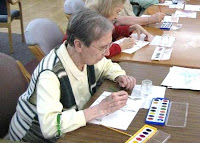
Summer 2009By fall of 2009, though, "bemusement" was rarely the word that came to mind. Senior Witch was falling repeatedly, yet she could not remember the falls or perceive how completely she had lost the capacity for self-care. At the same time, Crippled Wolf's father, the retired Lutheran pastor, was rapidly losing independence to Parkinson's disease.

Summer 2009"Mortality" was now quite decisively the word.

A brief passage from "The Dark, again," written after Senior Witch was hospitalized by a fall, sums it up:

The veil between the living and the dead is our own bodies. They are always thin, and they grow thinner by the moment.
More specifically, with regard to caretaking for Crippled Wolf's mother, the fact was that

Senior Witch has clearly moved into the childlike phase of Alzheimer's.

She still remembers people. She is still that sweet person who charms everyone she meets. She still sometimes summons the mental focus for brilliant conversation.

Usually, though, she takes a child's approach, making up explanations and excuses for troubling things that happen…including that fall. And she rewrites her own history, free-associating different real and imagined details to account for events…including that fall.

She is unlearning. The likelihood of teaching her new safety steps is questionable.
And here is where Crippled Wolf wonders if he made a mistake.

Not in the practical choices, as painful as some of them were. Senior Witch had to move into skilled nursing care—against her will but for her own safety. After a series of systemic infections and an increase in combative and escape-seeking behavior, she had to move to a different, secured nursing facility. The staff were gentle and loving, yet Senior witch resented being confined to a wheelchair as a "fall risk," no longer allowed her favorite activity of walking and wandering and visiting without accompaniment.

Crippled Wolf does not regret those choices, made out of what he came to call “compassionate ruthlessness,” the sort of choices a good parent makes for his child’s wellbeing, regardless of her own wishes.

What Crippled Wolf wonders is if he gave up on seeking introspective sharing with Senior Witch too soon. He knows he was afraid of asking her directly how she perceived and understood her own dying.

He circled round the topic one time in the first month after he moved her into skilled nursing care. They were sitting on a tree-shaded deck, watching Chinese geese in the large pond behind the facility.

“I’m remembering…,” he begins. “I’m remembering when you used to have long distance calls with your mother during her last years.”

“Yes,” Mom says, brightening a bit. “We used to talk on Sunday afternoons.”

“Yes, I remember.”

They sit.

She notices a spent yellow balloon, caught in the low branches over the pond.

“Grandma didn’t like moving to nursing care, either,” Crippled Wolf ventures.
“No.”

“She was angry about it.”

“Yes.”

They sit.

They notice other things. All of this time, they have been holding hands.

They hold each other’s eyes for a long time.

She doesn’t nod, but something flickers in her eyes, as if she were nodding.
Crippled Wolf regrets that he didn't ask outright while she could still answer. Perhaps they didn't need "the death conversation," since they had spoken so much to each other about faith and doubt, so deeply and so frankly, for so many years. Yet he wishes he knew....

He suspects that sometimes his "Quaker silence" is actually a defense mechanism, a way to avoid having to talk with others about his most intimate doubts, his most self-contradictory notions and prejudices and fears.

During her last year, Senior Witch often could not find words for what she wanted to say. If she spoke spontaneously, she could voice a cogent sentence or two. However, if she stopped to think, or if someone else asked a question which called for pondering, she could no longer manage to express her inner awareness in language.

St. Johns RiverFortunately, over the years, she had attended Quaker worship often enough to be quite at home sitting with Crippled Wolf and Hubby Jim in gathered silence. Eventually, in fact, she chose Quaker worship over the Lutheran service, simply because the latter had become too difficult for her to follow. They would sit with her several times a week in the nursing facility's riverside garden, just holding hands and watching the light on the water.

Crippled Wolf has been reading about the neurobiology of consciousness for about a decade now, so he knows from the research that the brain creates "self-awareness" through a complex, network of constantly shifting and interactive processes. He suspects that he watched this creative process in reverse with Senior Witch, as her Alzheimer's-afflicted brain became increasingly less able to sustain the whole assembly which constitutes conscious self.

He and Jim often noticed, when they arrived for a visit, that she would initially appear to be staring vacantly at something. When they spoke to her, she would gradually focus and recognize them with a beautiful smile. As the visit continued, whether or not they spoke much, her "self" would seem to reassemble, so that she gradually became more and more the person they knew and could interact with. Whatever her inner experience might have been, what they could see was that rising of "self" just enough to recognize and share presence with them.

Early the morning of Senior Witch's last Wednesday, Crippled Wolf awoke from a dream which he knew he needed to share with her. He went see her before work. She was in a recliner in the hall outside her room, lying in the morning sunlight. She smiled when she saw him.

"I dreamed this morning that we were at a party," he told her. "You and your three brothers and some other people were there. You were telling jokes, the center of attention, and everyone was laughing and cheerful."

Without a word, she nodded and smiled at him.

"Well, I have to go to work now," he said. "I love you."

She mouthed the words. "I love you."

Friday morning early, a nurse called to say that Senior Witch had been sick during the night. Crippled Wolf stopped at her room on the way to work.

At first she looked startled and distressed when she saw him. Then he held his left hand to the right side of her face. She closed her eyes and leaned against his hand.

That night, he and Jim watched as she gradually stopped breathing.

Crippled Wolf doesn't know if there is any continuity of the "self" after death. It's a familiar, traditional belief, yet he is not one of those people who—as the Quakers say—"knows this experimentally" (that is, experientially).

That, perhaps, is part of why he continues to be confounded, like the sled dog Max

She continues in memory, yet he doesn't know where she is.
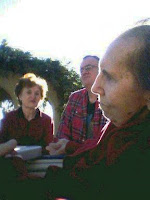
November 2010, with Jim and his sister, LibbieAnd so it is.

Blessèd be.

Saturday, January 15, 2011

Lois

Jim and I sat with Mom for the last couple hours of her life last night.

Before sunrise on Wednesday, I had awoken from a powerful dream, in which the vibrant, out-going Mom whom I haven't seen in several years was holding everyone's attention at a party with her three brother and other family and friends.

Later that morning, when I visited her at St. Catherine Labouré Manor, I found her in her recliner in the sunny hallway outside her room, her head pillowed against the hand rail since she could no longer sit up straight. As often happened, when she awoke and saw me, she lit up.

I told her briefly about the dream, and she smiled and nodded. We sat for a while. Once I saw that she was drifting off to sleep again, I said, "I love you." She mouthed the words back to me.

Last night, the nurse phoned us to say that Mom had labored breathing and very low blood oxygen. We sat with her as her breaths became slower and shallower, until she stopped breathing around 10:17 PM.

We are grateful for the time and love she has given so many of us.

Mom, August 2010

1924 - 2011

And so it is.

Blessèd Be,
Michael Bright Crow

Sunday, May 09, 2010

Ruthlessness

Crippled Wolf has been trying to help Walhydra get back to telling her story here. It isn’t easy, because they share a common grief, a common burden of seemingly overwhelming responsibilities.

Walhydra has been struggling for months—actually for several years—with the dilemma that worry and grief are difficult to turn into comedy. Through March and April, Walhydra's mother, Senior Witch, took another downturn due to a systemic infection. Walhydra has had to focus herself ruthlessly on "getting things done." No time for storytelling—except when she is crying with hubby Jim or updating family and friends.

"At least now," Walhydra says, "I usually recognize those first steps toward depression when they tempt me, and I’m fighting not to go there."

A small comfort but a real one, since she needs to be able to act.

As for Crippled Wolf, it's not that he feels the sorrow and loss any less. It's just that, being closer to the animal reality of humankind, he can be more dispassionate, more ruthless if necessary, in dealing with what happens to him.

Druid pack wolves runningHe feels grief, feels it deeply, yet it is something which happens in the stream of moment, not something which stalls the flow.

He howls his sorrow, yet he knows he must keep acting, keep running, keep hunting, keep playing—not to avoid or deny the pain, but simply to continue being.

Recently, Crippled Wolf's younger brother, one of the bravest men he knows, told a story on himself which resonates here.

Younger Brother has always had to be more of a maker, more of a scrapper, than Crippled Wolf needed to be. Third child, he was the spiritually orphaned high-schooler who had to find his own way, after his elder siblings left for college, when their parents were withdrawing into the silence which would eventually lead to divorce.

Younger Brother is a gifted actor, writer, teacher, director, yet he hasn't enjoyed much of the reliable mentoring and door-opening by elders which have flowed his brother’s way. He has had to father himself and to become a good father on his own. His blessing is that he has done both well.

For the past two decades, Younger Brother has fended for and defended his wife and son in a progressively more bankrupt northern city, where teen gang warfare encroaches on his neighborhood, where his artist wife has lost her non-profit child development job, and where the university he works for disdains the theater program they hired him to develop.

At the start of this year, the university suddenly moved the whole performing arts faculty out of a building they were tearing down and into temporary quarters, with no promise that a new building was in the works—and with no performance space of their own!

To make things more “interesting,” this year Younger Brother is acting chair of that department while the chair is on sabbatical leave. This means that, at the same time that he is teaching theater arts without a theater, directing two community group plays, and encouraging his wife and his brilliant college-senior son, he also has to manage the administrative needs of a displaced and frightened orphan faculty.

Oy!

Narrating all of this by phone one night, Younger Brother laughed almost maniacally.

“I’m finding that I just scale back my attention to the emotional distress of my colleagues when they bring problems to me. I listen, but then I set it aside and say, ‘Just tell me what you want to get done here.’ “

He laughed again.

“One program director hand-picked an associate fifteen years ago, but now they can’t be in the same room with each other. She comes to me with complaints about personality conflicts, and I just say, ‘But what do you want her to do? Make it clearer for me. What do you want to have happen here?’ ”

“Ah,” said Crippled Wolf, recognizing tactics for managing crisis from his own prison counselor past. “So you’re actually directing three plays.”

More than three!”

Crippled Wolf came away from this call with a paradoxical new name for an old notion: compassionate ruthlessness.

There are times when caring for people means maneuvering them to get on with business. There are situations—whole periods of life—when what is happening is too fraught with mortal consequence for us to nurse feelings. Feelings are information. Acknowledge the information, then act.

Cry later.

“You have to cry,” he says. “You have to honor the body’s need to release the grief. But do it later, after you’ve saved whatever lives or life you can save.”

Not nice. Not courteous.

Yet perversely salutary.

So, Wednesday morning, Crippled Wolf walked into the “secure” ward in the new skilled nursing facility to which he has had to move Senior Witch due to her increased escape-seeking and oppositional behavior.

Senior Witch glared fiercely from the wheelchair in which she is restrained, since the rehab staff haven’t released her back to her walker yet.

“This is the worst place I’ve ever been!” she growled. “This is like….” She couldn’t find words to describe it.

“Okay,” Crippled Wolf replied neutrally. “Well, let’s go get your glasses and hearing aids, and we’ll go walk in the garden by the river.”

He wheeled her to the nursing station, got her things, wheeled her to the garden path, and helped her climb out of the wheelchair, so that she could walk beside him.

They walked and sat and talked and watched the river and looked at the roses. Senior Witch surprised him, when he gave her a new card from one of her stepdaughters, but immediately reading the whole thing out loud to him.

They spent an hour together, just being.

He said nothing about her anger.

Back in the ward—after he had made sure the nursing staff saw how well she could walk—Crippled Wolf helped her back into her wheelchair. He knelt beside her, kissed her, and said, “I’ll see you this weekend. I love you.”

“I love you, too,” she said.

As he walked away, Crippled Wolf watched her genuine smile deflate into a forced one.

He knew he needed to get home, so that he could howl with Jim.

And so it is.

Blessèd Be.

Running Wolf

Tuesday, October 27, 2009

Grief and distraction

Dear Ones,

I decided to withdraw from Walhydra's Back Porch Part 1 of "Walhydra's White Slave Adventure." No problem with the story itself, but right now I don't feel like pursuing it.

I had started posting Part 1 late one night last weekend—as I now realize—in order to distract myself from my rising grief over moving Mom from assisted living into skilled nursing care.

Now the grief has broken through...or at least another layer of it has broken through.

I'm back on that tightrope I fell off of during 2007, when we moved Mom from her home to my sister's home, this time trying to maintain the balance between making the practical decisions and allowing the grief to hurt.

You all know about this in your own lives.

LoisWe are mortal.

Mother-Father God loves us and lifts us up.

But we are mortal.

Blessèd Be,
Bright Crow


Please see Cat's post Loss on Quaker Pagan Reflections.

Friday, November 02, 2007

Walhydra's year of becoming mortal

This one isn't at all easy to tell.

It's not that there's anything Walhydra is ashamed to reveal. Rather, she has wanted to write for several weeks, yet the source of the problem itself has prevented her.

Let's start it this way: last week Walhydra became part of a neurochemical experiment involving selective serotonin reuptake inhibitors (aka SSRI anti-depressants).

That was after she finally recognized just how much of her energy and concentration it was taking each day to tightrope walk with equanimity between anxiety and despair.

"Hell!" Walhydra says. "It's taking concentration just to make myself get out of bed in the morning...let alone do tai chi foundations, sitting meditation, bike riding, prayer, breakfast, or any of those other things which might nudge me toward wanting to do another day."

The crisis came two Mondays ago during the weekly LGBTQQFX bowling league, which Walhydra and hubby Jim usually enjoy so much.

"Well, I enjoy it now," Walhydra explains. "The first three years I hated it!"

Ever the self-critical Virgo, Walhydra used to get increasingly angry through each game, because she knew she could do better.

She pictures herself channeling her Swiss-German-Lutheran-pastor maternal grandfather, who used to utter a suppressed "Oh, pshaw!" whenever he bowled a bad frame. Except that Walhydra, not being a nineteenth century gentleman, utters things a bit less polite.

Finally, toward the end of last season, she realized she had to either quit bowling or stop caring so much. She started wearing a silly hat each week, joking with team mates instead of critiquing each ball she threw—and began to enjoy the company. And to bowl better!

The above seems like a digression, but the point is that Walhydra was having a fine evening that Monday, bowling high, laughing, feeling peaceful and relaxed, all through the first game.

Then, during the second game, hubby Jim mentioned that the thigh from which he had had a cancer removed about two decades ago, the thighbone which he subsequently broke about a decade ago, was aching.

A real-world cause for cautious concern, yes. But Walhydra literally felt her mood plunge from peak to pit and stay there. And stay there. And stay there.

"Alright," she said to Jim (with some difficulty, given her sudden sense of despair). "This is definitely brain chemistry out of whack."

Now, it might help the gentle reader to know that, as part of her current program of "becoming more mature," Walhydra has been amusing herself (ha ha) with the acknowledgement that she is of melancholic temperament.

Not that it's any news to her, but reading such an accurate (if unflattering) description of her character on a site quoting Rev. Conrad Hock about the ancient "theory of humors" actually made Walhydra feel better. To use her old social worker's jargon, describing her least favorite traits as just a part of her temperament normalized them.

"Like maybe I'm not hopelessly doomed by my utter moral failure in not being able to control my moods with reason? I'm just melancholic? Yeah, right!"

[Maybe it doesn't make Walhydra feel all that much better. The distance between irony and sarcasm is not very great.]

For Walhydra, a key passage from the website was this one:

[The melancholic] has a strong will coupled with talent and power, but no courage.... If difficulties in his undertakings are encountered..., even if they are only very insignificant, he feels discouraged and is tempted to give up the ship, instead of conquering the obstacle and repairing the ill success by increased effort.
Walhydra questioned the "no courage" part, but the rest is her at her worst. Fortunately, Swiss-German Virgo et ceteras are constitutionally averse to giving up the ship, so they keep hoping for some regimen of self-discipline which will bypass this trait.

Here were a few clues:
He should always, especially during attacks of melancholy, say to himself: "It is not so bad as I imagine. I see things too darkly...."

He must from the very beginning resist every feeling of aversion, diffidence, discouragement, or despondency, so that these evil impressions can take no root in the soul.
"Ah," said the rational part of Walhydra's mind. "Of, course. Rational-Emotive Behavior Therapy. Not quite my religion, but I can translate."

So Walhydra came up with a new version of her old "It isn't about me" mantra which went: "It's just temperament, not circumstance."

This worked for a little while.

Of course, Walhydra isn't dealing just with temperament but with deep down grief. Mortality.

In the past two years she has watched the deaths of Jim's father, several dear friends (the latest not three weeks ago), and the venerable family familiar whose passing inspired this blog, Miso the Cat.

Walhydra's eighty-something father, with whom she has gradually developed a loving adult friendship, is struggling with Parkinson's and other infirmities.

And, as the faithful reader knows, Walhydra's mother, Senior Witch, her closest friend and spiritual mentor, is declining into Alzheimer's.

This is not just temperament, or circumstance. This is Walhydra's own personal version of what every human being faces: death and the certainty of death.

It's enough to make one want to be beyond feeling.

And that, Walhydra now realizes, is what she has actually been working on in her haphazard morning rituals over the past year: trying to be "beyond feeling."

She hasn't been denying causes of grief or fear, yet she's been trying to avoid the slippery slope of melancholia. In the process, her brain has done what that organ knows how to do: suppress its own chemistry until Walhydra was deep in depression.

Ex-clinical counselor that she is, Walhydra started suspecting this a month or so ago. That Monday night's emotional plunge convinced her. The next morning she made appointments for a doctor and a counselor.

The doctor, a gently reassuring, semi-retired older man, commended Walhydra for still trusting her clinical judgment—and started her on a two-week SSRI trial.

The counselor, crew cut, jockish, maybe forty, was capable yet far less reassuring. Not through any fault of his own, but because he was from the newer, brief behavioral therapy school, rather than the "talk therapy" one for which Walhydra felt such a deep need.

"And he's too young. I know more than he does," Walhydra moaned to herself.

"Of course, dear," Goddess noted. "You're the elder here."

"But that's just the problem!" Walhydra insisted, annoyed at this divine interruption of her whining.

As self-reliant as she is, in periods of stuckness and despair Walhydra longs for someone older and wiser to turn to for comfort and guidance. Yet in her small circle, the "older and wiser" ones are her fading parents and her lost friends.

She has numbers of wise, supportive peers with whom she shares reciprocal friendships of encouragement and sympathy. But no intimate elders.

This is a new and distressing reality. The other title Walhydra had considered for this blog post was "Walhydra's orphan year."

So now here she sits again in her favorite coffeehouse on her Thursday off, eight days into the chemistry experiment.

In clinical terms, Walhydra knows that SSRIs take at least two weeks' dosing before they begin to reach an effective level. She also knows—now far too intimately—that their initial side effects can include a heightening of the very anxiety and depression they are meant to treat.

For most of the past week Walhydra has walked through generalized sadness, punctuated by long bouts with a hollow pang that grips her solar plexus.

"It's hunger, dear," Goddess suggests.

"No. Eating doesn't help."

"I mean hunger to get on with your life. You're feeling the feelings you were avoiding, magnified out of scale."

"My feelings are hurt and fear, damn it!"

"Yes."

"Yes what?"

"Just 'yes'." Goddess sighs. "You can't act and avoid at the same time, dear."

"But it drags me down so. I have to push myself through this chemical fog just to go through a day. I have to make myself eat, ride my bike, go to work. I have to keep myself busy every moment or I sink back into it."

"Yes."

Walhydra sags into her chair.

"There's no one to help me...except...." Walhydra feels a moment of lightness. "Except that Jim keeps hugging me and saying 'I love you'." She smiles slightly, despite herself.

"You see?"

"But he's gone all day. There's no one else."

"Ahem."

"Oh, yeah, well, there's you, I suppose."

"You suppose."

"I can't feel you. I know you're there...caring about me...but...."

Goddess ponders. "Go outside in the wind and touch that tree."

Without hesitating, Walhydra goes out into the bluster. As she steps off the pavement, the green of the damp grass shoots up almost through the crown of her head. She touches the rough bark of the tree and stands there. Still. The aching in her chest becomes quiet for a while. She goes back in to her table.

"It's gone again," she laments as the quavering seeps back in.

"Of course. That was only a reminder."

"Well...what good is that, it if doesn't stay with me the next moment?!"

"There is no magic, only belief."

"Oh! I hate it when you go all wise on me like that!"

"Duh!" Goddess giggles.

"I'm not getting important things done, damn it! I sat at the auto repair shop all morning, reading desperately to distract myself while I waited. I ate lunch. I took care of car insurance. I got the car washed and waxed. Now I'm here."

Walhydra glares at Goddess as if this explains everything.

"And...?"

"And I'm not getting Mom's business done. Legal work. Finances. Arranging in-home care for her Christmas visit. Finding assisted living in case she comes to need it. It's too scary. It hurts too much!"

Walhydra pauses.

"I feel like all I'm doing is plodding along and indulging my weakness."

"Nursing yourself."

"No. Well...."

"If you had a broken leg, instead of a broken heart?"

"Well...." Walhydra considers. "I'm afraid if I don't do this all well, that...."

Goddess holds Walhydra's gaze. "Everybody dies."

Silence.

"It keeps coming back to that, dear. However well you do, everybody dies."

More silence.

"You just do the finite amount you are able to do in a given moment. You don't measure yourself against anything else. Not even against your own history...or expectations. Just do what you can at the moment—even if it is only to breathe a bit more deeply."

Walhydra inhales slowly.

"See?"

Silence.

"Who do you think is going to punish you?"

"Huh?"

"You don't think 'God' will punish you for your finiteness, do you?"

"No! You know I don't believe that!"

"Then don't act like you do. Just go on."

"But...wait. Why do you bring 'Him' up? Aren't you both...?"

"Yes, yes. As you once said, I'm 'that same guy.' But you come to 'me' when you've let too much of that imaginary 'faux-christian boogeyman god' hide the real One's love for you."

She sits down beside Walhydra. "And when you want mothering."

"Yes."

Silence on both sides.

"So what do I do?" Walhydra asks at last.

Goddess gets a wicked grin. "Don't you read your own blog, dear? Just 'do the next thing'."

Walhydra frowns.

"Okay, try this then. Instead of your little intellectual mantra, try this one."

As Goddess stands up to leave, she peers into Walhydra's eyes—very deeply. Then she speaks softly.

"Joy and sorrow are weather, but the Spirit is the road."

And so it is.

Blessèd Be.

Note: LGBTQQFX = Lesbian, Gay, Bi-sexual, Transgendered, Queer, Questioning, Friends, and Xnyone-else-we-left-out.

Thursday, September 20, 2007

Walhydra cleans house

Walhydra has just returned from another extended ordeal back home in South Carolina, once more struggling to settle the property and financial affairs of her mother, Senior Witch, who moved to Walhydra's sister's home back in March.

This time Walhydra's goal was to empty out and clean Senior Witch's house, already on the market now for a month, but still cluttered with Walhydra's "inherited" furniture and other odds and ends.

Already worn down by six months of daily pre-dawn angst and grief clutching her sternum, Walhydra got on the road an hour late on Saturday. Hubby Jim's bright red Outlander had an almost flat tire, and it took Walhydra four gas stations before she found a working air pump.

Grr....

Walhydra hates this drive. Four hours north on I-95 (the Miami-to-Maine drug run). Then one west on I-26. Ugh!

She broke free by slipping instead up the old two-lane Highway 21, running from Yemassee to Orangeburg through farmland, tiny 19th century railroad towns—and convenience store stops where all the rural folks speak Spanish.

A slower road, but scenic and no traffic—and it's the hypotenuse of the triangle made by 95 and 26.

She arrived in the late afternoon and visited for an hour with Mom's dear neighbor Grace.

True to her name, Grace is a real evangelical Christian. That is, not one who professes; just one who practices at every moment, with every person, never proselytizing or voicing judgment, but simply offering gentle encouragement and support. It was a genuine blessing to reconnect with this saint.

Empty RoomEven so, when Walhydra went in to wander the nearly empty house, room by room, her sense of loss, in combination with her sense of too-much-to-do, was overwhelming.

She finally gave up and went out looking for dinner...but couldn't find anyplace which felt like home any more.

With a start Walhydra realized that Columbia, where she lived for over half her life, now feels suburban-sprawly and strange, whereas Jacksonville, which she hated when she arrived seven years ago, she now longs for as home.

Worse, hubby Jim wasn't with her.

She called him twice on her cell to whine about not liking this trip, before she finally found a branch of the local Mexican franchise they used to enjoy together. Not really home, but close enough to pretend.

Then she wandered through their old Barnes & Nobles haunt...but that felt too lonely, too.

At last she gave up and managed to lull herself to sleep in the guest room of Senior Witch's home, where her divorced parents' bedroom suite—Walhydra isn't ready to tell that story—still sits.

Sunday morning Walhydra popped awake at seven.

She's learned she daren't lie abed once her brain starts listing likely reasons for the angst-and-grief knot, so she jumped out, did limbering exercises, dressed, and roamed the rooms inventorying the tasks to be done...all before devotions or breakfast or any of that other sane, normal morning stuff.

After trips to Lowe's, Food Lion and BiLo for cleaning and packing supplies, she plunged in.

This is a beautiful one-storey brick house which Walhydra's step-father built with his GI Bill loan back in 1954. About midway through the day, Walhydra was using Murphy's Oil Soap on the handmade, built-in bookshelves in the den, when she started to feel the humble pleasure of that dear man's work in creating this home for his first wife—and sharing it with his second.

What's more, as Walhydra struggled—knee brace and back brace dutifully in place—to scrub the second...ugh!...application of Easy Off out of the 50-year-old Westinghouse range's ovens, she started to reconnect with what she remembered as Senior Witch's joy at housewifery.

As the eldest of three preacher's kids, Walhydra had been the one to absorb with the most doctrinal correctness—but also the most genuinely Pagan appreciation—the arts of taking care of a home.

Now, gradually, she found herself doing for her mother that same, reverent sort of house-cleaning. Making sure that every little detail—even those a potential buyer might not notice right away—was as well done as Senior Witch would want an eventual housewife or househusband to find it.

She remembered what she had told Senior Witch:

"My brother Marty told me that, even with the furniture gone, it didn't feel like an empty house. It still felt like a warm, lived in home. Your home.

"So...you have the sadness of having left your home behind. But you have left behind a home, not just an empty house, for the next family to move into."

Walhydra spent another day and a half on this chore, squeezing in visits with the financial advisor, the tax accountant, the listing agent, the Orkin man, and the firm which reinforced the sagging foundation of the den.

All that plus three ultimately unsuccessful trips to Lowe's to try to match the drip bowls for the 50-year-old range. Oh, well....

(She finally gave up and restored the old ones, "hiding" the rusty one in the back.)

She also managed a very good evening with her Dad, the Lutheran pastor, and her step-mother, and another with her dear computer guru friend Jay.

*whew*

Oh. And there was the matter of deciding what of Senior Witch's trove of lifelong "saved items" to keep, what to give away, and what to kick reverently to the curb.

Namely, all the neatly folded paper and plastic bags, the washed and flattened aluminum foil, the jelly jars and plastic take-home boxes, the thread-bare towels and wash clothes kept as rags, the salvage from various hospital stays, the 1963 Encyclopedia Britannica, the reams of discontinued letterhead from Senior Witch's last job. And so on....

Today, back at the library, Walhydra was talking about these marvels with a colleague who shared a similar story about her own Depression-era parents.

"They were using frugality to take care of their families and, at the same time, taking care of the earth without knowing it," the friend said. "They didn't think about 'ecology' or 'sustainability.' They just didn't waste anything."

Yes.

So Walhydra—both alarmed and amused by her own 21st century ruthlessness—admired once more Senior Witch's consummate housewifery, even has she tossed out a nearly 10-year-old bottle of murky cooking sherry.

Well, it all got done. By Tuesday, 4 PM, the house was clean and empty of everything but Walhydra's piano, sofa and bedroom suite—which she still has to find someone to move.

She gathered the odds and ends she was carrying home into the Outlander. Packed the vehicle with all the precision and efficiency she remembered her preacher Dad using for summer cross-country family vacations.

Then she went for one last walk-through...and realized that she had to—oh, no!—do a ritual of parting.

What she did was spontaneous, yet almost as familiar as breathing.

When Walhydra was a little boy back in Ohio, she used to love the quavering voices of the old ladies in her Dad's Lutheran church as they sang the Offertory from Psalm 51.

A couple decades ago, Walhydra rediscovered these verses as a mantra and prayer, one she uses daily, sometimes several times daily.

Usually Walhydra associates each line with a chakra, which she clears and opens as she says the words. But on this day, she sang the old, simple melody.

She walked from room to room, stopping at each doorway to picture Senior Witch, her stepfather, the family who grew up in this house, or hubby Jim and herself on the many Thanksgivings and Christmases and regular weekends when they visited or stayed over.

"Create in me a clean heart, oh God...."

The guest room. Already her throat felt tight.

"...and renew a right spirit within me."

The back room, where Senior Witch liked to lounge and read, and where the ancient computer used to sit.

"Cast me not away from thy presence...."

The master bedroom. Two marriages, two families, and then Senior Witch's last years here alone.

"...and take not thy holy spirit from me."

The master bath.

"Restore unto me...."

The breakfast nook and kitchen....

And here was where Walhydra started crying.

All that life, from as early as she can remember, of watching Senior Witch cook meals. And those last decades here, after her stepfather's death, when her Mom quit cooking, but Walhydra and Jim would do special holiday dinners.

Kitchen. Hearth and home.

Walhydra wandered on into the den. Walked over to the space where Mom always read or watched TV in her rocking chair.

"...the joy of thy salvation...."

At last, into the living room, singing weakly.

"...and uphold me with thy free spirit."

Walhydra walked out, pulled the door shut and locked it. She went next door to Grace's, wiping her tears on the way.

Grace was true to her name again. "It's been a very profitable visit for you."

"Yes. Thank you so much."

"Thank you."

They hugged and parted.

Walhydra realized she had left a water bottle in the fridge. She went back into the house, the kitchen, to get it.

And she found herself retracing her steps from room to room, saying "Joy!" at each doorway. "Joy," especially, at the site of the rocking chair.

She left and locked up again, and headed back down I-26 and I-95.

A couple of hours later as she drove, Walhydra was listening to Marvin Gaye’s “Keep on dancing."

She could feel her excitement, and—there's no polite way to say this—she got to where she was bouncing her pelvis on the driver's seat as she sang along.

Picture this aging, gray-bearded white guy in a bright red Outlander, cruising down the highway past the truckers and third-generation yuppies, singing out:

I used to go out to parties
and stand around
'cause I was too nervous
to really get down
but my body yearned to be free
I got up on the floor and thought
somebody could choose me
No more standin' there beside the walls
Finally got myself together baby
and I'm havin' a ball
As long as you're groovin'
there's always a chance
somebody watches
and might wanna make romance
Move your body, ooo baby, you dance all night
to the groove and feel alright
Everybody's groovin' on like a fool
But if you see me spread out and let me in
Baby just party high and low
Let me step into your erotic zone
Move it up
Turn it 'round
ooo Shake it down
OOWW
You can love me when you want to babe
This is such a groovy party baby
We're here face to face
Everybody's swingin'
This is such a groovy place
All the young ladies are so fine
You're movin your body easy with no doubts
I know what you thinkin' baby
you wanna turn me out
I think I'm gonna let you do it babe

Keep on dancin'
You got to get it
Got to give it up
And so it is.

Blessèd Be.

Thursday, June 21, 2007

Walhydra's sadness

Back in Walhydra's teen years, when she was still a closeted sissy-boy but didn't know it yet, she latched onto this verse from the Book of Job (5:7)—though it's probably actually a line she got from Linus Van Pelt of Peanuts:
Man is born to suffering as the sparks fly upward.
Even though Walhydra's suffering had been, till then, mostly of the generic teen sort—or, more accurately, the generic teen-closeted-sissy-boy-but-doesn't-know-it-yet sort—she thought that just knowing that verse made her feel somehow more mature.

A few teen years later, Walhydra stumbled onto poet Archibald MacLeish's modern version of Job, J.B.
Fascinated by a performance of the play, she devoured the script and memorized a key verse which just leapt out at her.

The line is spoken early in the play by Nickles (“Old Nick” aka Satan) to Mr. Zuss (God):
I heard upon his dry dung heap
That man cry out who cannot sleep:
"If God is God He is not good,
If God is good He is not God;
Take the even with the odd,
I would not sleep here if I could,
Except for the little green leaves in the wood
And the wind on the water."
Granted, this verse is the beginning of Nickles’ cynical challenge to Zuss to let him torment J.B. And, granted, Walhydra didn't actually believe its despairing message.

Nonetheless, she recited the line to herself throughout her college years, as if it posed a challenge to her that her own adolescent faux-cynicism wasn’t yet up to understanding.

Looking back on this verse decades later, Walhydra now recognizes that the problem it speaks to has, in fact, driven her spiritual puzzlement for much of her life.

"It just doesn't work for me to believe that God (or Goddess, or Whatever…
) causes suffering. Or even that He/She allows it.

"I know that doesn’t make any sense," she equivocates. "But the only evil I see done is done by human beings."

"So why doesn't God stop evil?" she imagines the gentle reader asking. "Why does God let anyone hurt or kill innocent people?"

Walhydra pauses. "Why does God let a hawk kill an innocent mouse or a tsunami kill thousands of innocent human beings?"

"That's not the same."

"It's not?" says Walhydra, amused to find herself playing the Socratic role which Goddess usually plays opposite her.

Although she can't pretend to be wise or enlightened—well, actually, she pretends both all the time—Walhydra has somehow come to understand that human beings are mortal, just like other animals.

And that suffering just happens. Not as punishment. Not as fate. Just as part of the mechanics of being mortal.

"I don't mean that we shouldn't care about suffering. That we shouldn't avoid or try to prevent suffering for ourselves and others."

She glances about warily, feeling somewhat awkward about channeling Goddess.

"I just mean that it happens anyway."

Or, as a Zen precept she often quotes says:
Renunciation
is not about giving up
the things of the world,
but accepting
that they go away.
So...somewhere between the theist Jew's sparks flying upward and the nontheist Buddhist's things going away, last week on the New Moon, Walhydra called her mother, Senior Witch, early in the morning.

The faithful reader will remember that Senior Witch had relocated
to the home of Walhydra's sister in Pensacola, Florida, back on St. Padric's Day. Alzheimer's was making it unsafe for her to continue her independent, self-sufficient life in her home of forty-some years.

"I'm okay, but I'm feeling homesick," Senior Witch says, reciting the line with which she now begins every phone call.

Walhydra is feeling more than usually connected this morning, so she says without even pausing, "Yes, Mom. I think homesickness is just going to be a part of your life from now on."

There's a momentary silence.

"There's no way to feel good about losing your friends and church and neighbors back in South Carolina," Walhydra continues boldly. "I wonder who your new neighbors are?"

This gets a bit of exploratory conversation going.

The problem is that Senior Witch has declining hours of lucidity, declining hours when she can retain the mental focus and energy of an adult. That means even the best ideas—even the ones she embraces with enthusiasm when Walhydra shares them—fade into wishful thinking or forgetfulness before she can act.

What's left, Walhydra recognizes sadly, is to give her mother moments of affirmation or hope. Moments which Senior Witch will relish—and then forget.

"Mom?" Walhydra continues. "You remember that my brother drove down from Massachusetts to meet me in Columbia last week?"

"Uh-huh?"

"Well, he got there a day before me to clean your whole house from top to bottom, to get it ready to sell."

"Uh-huh?"

"And—" A lump starts in Walhydra's throat. "And he told me that it didn't feel at all like an empty house. It still felt like a warm, lived in home. Your home."

"Oh."

Walhydra is well into Quaker vocal ministry by now, saying things she hasn't even thought of.

"So...you have the sadness of having left your home behind. But you have left behind a home, not just an empty house, for the next family to move into."

"Oh. Oh. I'm so glad you told me that!"

"I thought it was important for you to know."

"Yes."
Senior Witch on her back porch in Columbia
Recalling that exchange tonight, near midnight on Summer Solstice a week later, Walhydra suspects that Senior Witch may not even remember it. She knows that she will repeat her brother's message whenever she can work it into conversation.

And the line about homesickness.

And the line about new neighbors.

Like any adult, trying through repetition to reassure a child that the world is safe—even glorious, even wondrous!—to live in, with little green leaves in the wood and wind on the water.

Even though the sparks fly upward and we can't avoid having things go away and we all die.

This doesn't feel very good to Walhydra right now.

But it's not God's fault.

It just is.

And so it is.

Blessèd Be.

Wednesday, May 02, 2007

More grace

Being Walhydra all the time is just too much work. At least that's how she's been feeling lately.

"Can't I please be someone else?" she asks.

Sorry, Dear," Goddess says. "I put in just the mix of ingredients I intended you to have for this incarnation. You're still trying too hard. Why don't you just go out for a little walk?"

"That won't do any good," Walhydra sulks.

"Probably not, in your case. But it's a nice day. Now run along."


This morning and yesterday morning were two variants on a frustrating theme which has been playing itself out for months now.

On Tuesday she awoke promptly at 5 AM—the alarm was set for 6 and she's been tending to sleep in till 7—and she knew she might as well get up. Monkey mind was already chanting the litany of work- and Senior Witch-related responsibilities which burden her days and nights.

Tuesday the tai chi, meditation and prayer did well their job of centering Walhydra into a healing awareness of the Divine Presence.

This morning, on the other hand, the alarm went off at 5...wah!...because she had set the clock wrong. She reset it for 7, woke again at 6, shut off the alarm, hid under the covers till 7:15—and finally couldn't stand it that the litany was still running.

Wash face, dress, walk out the door.

Walk the cool morning neighborhood. Squirrels, cats, birds, blossoms. Things which usually bring Walhydra back into the Sacred Present.

Not today.

But by the time she has returned home, hubby Jim is up, in his bathrobe, getting his breakfast.

As the gentle reader as surely figured out by now, Walhydra comes from a family of talkers. Being a preacher's kid, her first expectation is always that problems can be solved—if at all—by talking them out.

But Walhydra is sooooo tired of talking about all this, and it isn't working anyway.

So she just looks up sadly from the chair she's slumped into and says, "There's this deep down despair...I just keep getting stuck in the mornings with all the details...."

Hubby Jim walks over without hesitation to stand beside Walhydra. He hugs her head gently to his belly, and says, "I love you."

*sigh*

A few silent moments of this.

Then Walhydra stands for a hug. Warm, long, full-body, as Jim always readily gives them.

She gets a catch in the throat and it names itself: "Mom."

It's not about all the details. It's still about the loss.

After a while, Jim leaves for work.

Walhydra sits on the back stoop with breakfast, watching squirrels, cats, birds, blossoms. It's so quiet and reassuring. Such a welcoming Present.

What is grace? This morning it is—as often—this amazing hubby of hers who knows to hug instead of talking.

Walhydra asks Goddess when she can make an end of recycling the same challenges of loss and responsibility.

Goddess grins.

"To paraphrase Charlton Heston: ' When you're finished.' "

She stirs the breeze a bit.

"But meanwhile, Dear," she whispers, "ask for more hugs."

Blessèd Be.

Sunday, April 29, 2007

Walhydra's first "senior meal"

Walhydra knows that there is a dark side to that latest story about her mother, Senior Witch.

"I thought that was the dark side," the gentle reader might be wondering.

"Well, yeah," a somewhat subdued Walhydra replies. "It wasn't the cheeriest of tales, was it then?"

She glances around awkwardly.

"But you see, Mom put her finger right on the sore spot. Remember what she said?

" 'For years I've been telling myself I was going to die perfectly healthy.' "

Walhydra isn't laughing.

This week Walhydra read straight through a weirdly brilliant "young adult" novel called I Am the Messenger, by award-winning Australian thirty-year-old Marcus Zusak. She recognized him from the very first pages as one of those youngsters who is "wise beyond his years."

Granted, going all the way back to childhood, a now rather envious Walhydra has liked to think of herself as "wise beyond her years." Unfortunately, since she never liked to be caught out speaking in error, she mostly kept it to herself—unlike this young genius. Now she suspects her years are beyond her wisdom.

In any event, at a pivotal moment in Zusak's novel, his first person narrator Ed says the following:

It's impeccable how brutal the truth can be at times. You can only admire it.

Usually, we walk around constantly believing ourselves. "I'm okay," we say. "I'm all right." But sometimes the truth arrives on you, and you can't get it off. That's when you realize that sometimes it isn't even an answer—it's a question. Even now, I wonder how much of my life is convinced.

I get to my feet and join [my friend] Ritchie in the river.

We both stand there, knee-deep in water, and the truth has well and truly pulled our pants down.

The river rushes by. (304)
Walhydra has had her own pants down for much of this same week. Unproductively, so to speak.

As part of her diligent Virgo program of "dying perfectly healthy," a year ago she joined the local taoist tai chi class. It's actually made noteworthy difference to her in terms of limbering up her posture and unkinking fifty-mumble years' worth of asymmetrically stored psychosomatic stress.

Joking aside, she seriously recommends this practice.

Nonetheless, it doesn't make incarnate the Virgo fantasy of returning an old body to its unblemished and divine wholeness. Darn.

Instead, what the practice does do is to give one a template towards which to aspire.

What delights and fascinates Walhydra is this. This far along with her practice it will happen that, at any given moment, walking, standing, sitting, driving, her body will notice miniscule misalignments—a left shoulder slightly raised, a right psoas muscle failing to release enough to square her hips—and will make the correction as best as the ancient nerves and muscles can.

"Ancient?!" Walhydra objects, seizing the fountain pen from the hand of her amanuensis. "Just write what I tell you. Don't editorialize!"

The point is that tai chi is slowly restoring a bone-deep body sense which Walhydra has known only sporadically since her bout with non-paralytic polio at age four. This gives her hope.

But about that dark side.

Two Saturday's ago, Walhydra joined her class for a day-long intensive workshop. Despite the sound of that word "intensive," it was a pleasant day of gentle, deep-muscle workout and friendly socializing—until it was followed by a long night of aching, groaning, upset stomach and cramping bowels.

"Oh," Walhydra said in the pre-dawn darkness. "That's right. This is Chinese 'alternative medicine' exercise, releasing old toxins into the blood stream. I need to hydrate!"

Four days of hydrating later, four days of unproductive pants-dropping—despite doses of the liquid chalk some wag cleverly misnamed milk of magnesia—and Walhydra is saying, "Somethin' ain't right!"

She makes a doctor's appointment for Friday.

On Thursday night, Walhydra and hubby Jim are out for dinner with four of their fifty-something gay bowling league buddies. And they're all joking about it!

When she heads for the men's room at one point, Walhydra taps the guy next to her and says, "It's not the emergency you feared sitting in the way of. More likely just wishful thinking."

Upon her return—unproductive again—she asks her fellow geezers, "Did any of you think in your 20s that you'd be joking about stuff like this in your 50s?"

All shake their heads no, sobered by this strange, privileged camaraderie of having lived longer than most of the human race and yet still being prosperous and active.

Privately, Walhydra's Pagan buddy in the group says, "I wonder if it's all the grief and sh-t about your Mom that you're not yet able to let go of?"

Walhydra nods. "I've thought of that. It's bound to be part of what's going on."

But it's not only grief and sh-t about Senior Witch. Walhydra can't keep denying that she is older, too.

Yeah, tai chi is loosening things up for her—well, some things. Yet when she watches the progression of her Mom's failing memory, she's also aware of her own. And the doctor has been warning her about her not-yet-diabetic-but-rising blood sugar level. And the dentist wants her to cap the forty-year-old filled molar and the yellowed, root-canalled eye tooth.

For decades, Walhydra has been secretly delighted that people routinely mistake her from at least ten years younger than she is. During her prison counselor years she used to joke that she grew the goatee "because that's the only place I get gray hairs—and I've earned them."

But, as the Chiffon commercial used to say....

When Walhydra was making one of her recent lone trips to South Carolina, before Senior Witch moved to Pensacola, she stopped near Savannah for a pancake lunch. Browsing the menu, she realized she wasn't really up to eating five pancakes. Then she turned to the back page.

"Perkin's '55 Plus'!" it read. Three pancakes for the senior citizens' price.

"Hmm...," she thought bemusedly. And, like the baby bear's—or maybe grampa bear's—portion, it was just right.

Hmm....

On Friday, the physician's assistant finds nothing of concern in her physical exam of Walhydra's cramped up abdomen. An x-ray to rule out blockages finds nothing either. So the P.A. says to up the water and "milk" and fiber-rich foods...and wait.

That night things are—*phew!*--more productive.

At work on Saturday, Walhydra jokes with a soon-to-retire crony.

"By this age, I've learned to just laugh at my own psychosomatic ailments, instead of worrying about them," she says. "So I had to get the doctor's permission to start sh-tting again. Oh, well. It's silly, but it's a lot easier and quicker than psychoanalysis."

By this age?

Here, then, is the dark side. Trying to keep Senior Witch from aging and dying comes out of genuine fear of her loss. But someone else doesn't want to age or die either—despite her sometime enlightenment.

"If I could just eat the right diet, do this tai chi faithfully, get serious about cardiovascular workouts at the Y...."

Every once in a while, in the midst of her holier-than-thou rants, Walhydra acknowledges being a product of her culture's fears and fantasies, a mortal like all other mortals.

As she sat in Perkins eating that third pancake a couple months back, she thought about her chronic "fifty-mumble" joke. Then she tried out a different line, just to see what it would feel like.

"I'm almost sixty."

Hmm....

Tuesday, April 24, 2007

Which next thing?

Walhydra realizes that she has created a dilemma for herself.

Well...actually she's created quite a few in her lifetime, but this one has to do with blogging.

The dilemma is this: How can she keep to her goal of writing nothing but sarcastic humor when, for much of the past few months, real life has tended to shut her down with grief and depression—disguised most often as a paralyzing sense of urgency?

"What?" the gentle reader exclaims. "You didn't tell us about that!"

"Of course not," Walhydra rejoins. "It isn't funny!"

As her amanuensis keeps pointing out, the constraints of satire censor out far too much of Walhydra's palpable human experience. She has to wait—especially after pain—until she can laugh about it, in order to be able to share it with her audience.

"So, what would you say?" she challenges him.

"I would say: I'm losing my mother.

"She's 83 and at least a year into early Alzheimer's. Last month, on extremely short notice because of a minor seizure, my siblings and I decided we had to uproot her from her home, church and neighborhood of forty years and move her to my sister's home, 600 miles away in Pensacola.

"I would say: She's still alive and safe. She's with family, with grandchildren, and putting the best face on it she can.

"But she's not the always-available best friend I've known most of my adult life. She's a sad, forgetful, disoriented refugee.

"And I can't take care of her the way I always have."

Long pause.

"Are you finished?" Walhydra asks, rather more meekly than she had intended.

"No," he says softly. "There's this: She can't take care of me anymore, either."

This is when both of them have to stop to deal with tight throats and tears.

Walhydra's usual manner, especially in crisis, is to be as professional as she can be.

Efficient social worker, doing triage. What's most important, right now, for Mom's safety and comfort? How do we get it done in the quickest, simplest way possible?

And then: How in the world do I deal with all these new financial and legal matters? With selling a house long distance? With supporting my angel of a sister as best I can? With keeping my loving brother up in Massachusetts in on the process?

With catching up on the job I've been away from for three weeks?!

All these responsibilities reel out before Walhydra, and she manages each as well as she can...at least until the crisis itself is past. Then she notices that there are all sorts of unfinished pieces lying around her—and that she has ground to a halt in an oddly numb panic.

Her sister shares a wise pastor's words: "Just do the next thing."

"But there are three dozen next things!" Walhydra cries. "Which next thing?"

After a few weeks of floundering and stalling—with, by grace, some genuine nurture from hubby Jim and friends at work and elsewhere—she notices another very quiet voice.

"The next thing, Dear, is to grieve."

"What...? Who...? Oh," Walhydra gradually realizes. "It's You. I wondered where You'd got to!"

An indulgent chuckle, like Spring brushing last year's leaves aside. "Silly old witch! You've been talking with me nonstop for weeks now."

"Oh, I know," Walhydra pouts. "I've been praying minute by minute for weeks now. 'Keep me in the present...help me center...guide my hand'."

"Yes, Dear," Goddess acknowledges. "You've been very courageous and faithful. But you haven't stopped. Except when you're unconscious in bed—and not even then."

She pauses.

"There's someone else you have to take care of besides your Mom."

"I don't have time."

"Um...."

Of course, Walhydra knows better.

In one of her earlier heart-to-hearts with her Mom, Senior Witch, she had steeled herself to say something out loud, allowing her sobs to come as she spoke.

"I've realized a way I've been fooling myself for the past few years. I've been pretending that if I just did a good enough job of managing things and providing for you, you wouldn't grow older and die."

Her mother hugged her, and they were quiet together for a while.

Then Senior Witch said, "I've realized something, too. I've realized that for years I've been telling myself that I was going to die perfectly healthy. Isn't that silly?"

They both laughed.

Goddess nods as Walhydra recalls the story.

"Yes," She says. "We have to keep reminding ourselves that we're mortal."

"Whadaya mean, 'we'?" Walhydra squints at Her a bit angrily.

Goddess just looks back, pretending to be inscrutable.

"My point is, you're allowed to be mortal. You're supposed to be mortal. You're not supposed to forget. It's when you forget that you play these hurtful games with yourselves and each other."

"But...but...."

"I know. It doesn't feel good. It's scary. It hurts."

"It hurts like hell!"

"Oh? No it doesn't." Goddess gives her Mona Lisa smile. "Not nearly that much."

Walhydra sits up, glaring. "You don't even believe in Hell! You claim it's something we made up to keep each other in line."

"I think you've changed the subject, Dear."

"Oh?"

"We were talking about you. Grieving. Or not wanting to."

"But I do...."

"Want to...?"

"No. Grieve."

"In your precise, Swiss-Lutheran-Virgo-Buddhist-Quaker-Witchy way."

"Stop teasing!"

Goddess holds her close for a while.

Late on the night of the day when Walhydra and her siblings decided they needed to move their mother, she and Senior Witch had said their goodnights and gone to bed.

Walhydra had tried to lay out the plan to her Mom, but only in a general sort of way. This was, after all, Senior Witch's first day home from hospital after the seizure, and she hadn't seemed all that well focused in the present.

Of course Walhydra couldn't sleep. She wandered into the darkened living room to try relaxation exercises and zazen. And of course her mind wouldn't stop.

But then it did.

And then the silence said: "You have to tell her what hurts."

Walhydra got up and walked toward her Mom's room, just as her Mom came out the door.

"I have to tell you...."

They went back to sit on Senior Witch's bed.

"I feel terrible that I'm...*sob*...taking you away from your home, after all this time of trying to keep you here."

Her Mom held her.

Then, "So, you're saying I have to move right away." A statement.

"Yes. Because of what we've been observing, what your friends have been observing, this past few weeks."

"Tell me what you've been observing."

Walhydra told her.

The constant forgetfulness. The losing of prescription meds in the wastebasket. The distress calls about minor problems which had already been resolved. The failure to feed herself well or even buy groceries.

"Then I have to move."

Walhydra marveled at the Senior Witch she remembered, back in the present for this crucial moment.

"Yes," she said.

They talked for a while, in love with each other, about how they managed to have such conversations. For years they had been adults with each other.

Senior Witch and the Amanuensis
They had learned not to protect each other's feelings.

That is, they had learned that "I'm trying to protect her feelings" actually means "I'm trying to protect myself from her feelings, if I tell her how I feel."

Now they just talked.

"Do you remember," Walhydra asked, "back in September, when we went to rent a DVD that last night? You picked Iris, about Iris Murdoch's decent into Alzheimer's.

"And I kept wondering, all through the movie, 'Does Mom know this is what's happening to her? Is she trying to tell me something?' "

Senior Witch did her own Mona Lisa smile.

"I knew. And, no, I wasn't trying to tell you anything."

Walhydra looks up from her reverie at the Goddess.

"I feel like she's gone."

"Sometimes she is, Dear. Increasingly so. You can't bring her back."

They sit in silence.

"But you can keep talking to the Mother you remember. Keep writing to her. Even if she doesn't answer very well out of that body, out of that brain, she hears you."

"Don't get metaphysical on me, okay?!"

Walhydra doesn't like to admit how New Age-y even the most ancient religious assurances sound to her...or how much she wants to believe in them.

"Nothing meta- about it, Dear. We do hear you. Even if that body and brain are too tired to carry on much longer."

She stands and stretches, grinning in her usual, satisfied way.

"Just keep telling her, 'I love you.' That's enough."

And so it is.

Blessèd Be.