Showing posts with label The Dark. Show all posts

Sunday, July 10, 2011

Bereft

bereave: O.E. bereafian "to deprive of, take away, seize, rob," from be + reafian "rob, plunder," from P.Gmc. *raubojanan, from PIE *reup-, *reub- "to snatch." A common Germanic formation (cf. Du. berooven, Ger. berauben, Goth. biraubon). Since mid-17c., mostly in reference to life, hope, loved ones, and other immaterial possessions. Past tense forms bereaved and bereft have co-existed since 14c., now slightly differentiated in meaning, the former applied to loss of loved ones, the latter to circumstances.
Crippled Wolf continues to be confounded by his mother Senior Witch’s death in January.

In the 2006 movie Eight Below, a team of husky and malamute sled dogs take care of each other and survive for six months in Antarctica after a severe storm forces their human companions to abandon them.

Eight Below (Max, center), by Walt Disney StudiosThe part of the story which resonates most for Crippled Wolf comes when Dewey, one of the huskies, falls off a steep slope and is fatally injured. The other dogs stay to comfort their teammate until he dies, but then they move on—except for the youngest dog, Max. Max, seeming not to understand what has happened, stays beside Dewey’s body for a day or so longer before following the others.

Crippled Wolf sees himself in Max. Rationally he understands what death is, yet that deeper animal part of him continues not to understand.

How can a person simply stop being?

He keeps going back to that bed with the curtains drawn around it and sitting next to the body, just as he did repeatedly on the night his mother died. Looking at the still face, touching the hands. Unable to reconcile memory of her with physical reality.

He keeps going back to earlier moments when, directly or indirectly, he and his mother acknowledged that she was dying.

There was the Sunday night in March of 2007, when he and she agreed that she needed to leave her home of forty years to live with his sister. Crippled Wolf is startled, as he rereads the story, to discover how much he knew when he told it that he didn't know he knew. But, then, that is part of the blessèd mystery of storytelling.

One passage which stands out now:

In one of her earlier heart-to-hearts with her Mom, Senior Witch, [Walhydra] had steeled herself to say something out loud, allowing her sobs to come as she spoke.

"I've realized a way I've been fooling myself for the past few years. I've been pretending that if I just did a good enough job of managing things and providing for you, you wouldn't grow older and die."

Her mother hugged her, and they were quiet together for a while.

Then Senior Witch said, "I've realized something, too. I've realized that for years I've been telling myself that I was going to die perfectly healthy. Isn't that silly?"

They both laughed.
Summer 2008, Columbia, SCAnd another passage:

"Do you remember," Walhydra asked, "back in September, when we went to rent a DVD that last night? You picked Iris, about Iris Murdoch's decent into Alzheimer's.

"And I kept wondering, all through the movie, 'Does Mom know this is what's happening to her? Is she trying to tell me something?' "

Senior Witch did her own Mona Lisa smile.

"I knew. And, no, I wasn't trying to tell you anything."
Three months later, Crippled Wolf was trying to comfort his mother through her homesickness. A year after that, once Senior Witch moved to assisted living in his own town, Crippled Wolf began taking her to Lutheran church services, so that she would feel more at home. He was bemused by their contrasting experiences of the same "structured worship.” Nonetheless, introspective awareness was something they could still talk about.

Summer 2009By fall of 2009, though, "bemusement" was rarely the word that came to mind. Senior Witch was falling repeatedly, yet she could not remember the falls or perceive how completely she had lost the capacity for self-care. At the same time, Crippled Wolf's father, the retired Lutheran pastor, was rapidly losing independence to Parkinson's disease.

Summer 2009"Mortality" was now quite decisively the word.

A brief passage from "The Dark, again," written after Senior Witch was hospitalized by a fall, sums it up:

The veil between the living and the dead is our own bodies. They are always thin, and they grow thinner by the moment.
More specifically, with regard to caretaking for Crippled Wolf's mother, the fact was that

Senior Witch has clearly moved into the childlike phase of Alzheimer's.

She still remembers people. She is still that sweet person who charms everyone she meets. She still sometimes summons the mental focus for brilliant conversation.

Usually, though, she takes a child's approach, making up explanations and excuses for troubling things that happen…including that fall. And she rewrites her own history, free-associating different real and imagined details to account for events…including that fall.

She is unlearning. The likelihood of teaching her new safety steps is questionable.
And here is where Crippled Wolf wonders if he made a mistake.

Not in the practical choices, as painful as some of them were. Senior Witch had to move into skilled nursing care—against her will but for her own safety. After a series of systemic infections and an increase in combative and escape-seeking behavior, she had to move to a different, secured nursing facility. The staff were gentle and loving, yet Senior witch resented being confined to a wheelchair as a "fall risk," no longer allowed her favorite activity of walking and wandering and visiting without accompaniment.

Crippled Wolf does not regret those choices, made out of what he came to call “compassionate ruthlessness,” the sort of choices a good parent makes for his child’s wellbeing, regardless of her own wishes.

What Crippled Wolf wonders is if he gave up on seeking introspective sharing with Senior Witch too soon. He knows he was afraid of asking her directly how she perceived and understood her own dying.

He circled round the topic one time in the first month after he moved her into skilled nursing care. They were sitting on a tree-shaded deck, watching Chinese geese in the large pond behind the facility.

“I’m remembering…,” he begins. “I’m remembering when you used to have long distance calls with your mother during her last years.”

“Yes,” Mom says, brightening a bit. “We used to talk on Sunday afternoons.”

“Yes, I remember.”

They sit.

She notices a spent yellow balloon, caught in the low branches over the pond.

“Grandma didn’t like moving to nursing care, either,” Crippled Wolf ventures.
“No.”

“She was angry about it.”

“Yes.”

They sit.

They notice other things. All of this time, they have been holding hands.

They hold each other’s eyes for a long time.

She doesn’t nod, but something flickers in her eyes, as if she were nodding.
Crippled Wolf regrets that he didn't ask outright while she could still answer. Perhaps they didn't need "the death conversation," since they had spoken so much to each other about faith and doubt, so deeply and so frankly, for so many years. Yet he wishes he knew....

He suspects that sometimes his "Quaker silence" is actually a defense mechanism, a way to avoid having to talk with others about his most intimate doubts, his most self-contradictory notions and prejudices and fears.

During her last year, Senior Witch often could not find words for what she wanted to say. If she spoke spontaneously, she could voice a cogent sentence or two. However, if she stopped to think, or if someone else asked a question which called for pondering, she could no longer manage to express her inner awareness in language.

St. Johns RiverFortunately, over the years, she had attended Quaker worship often enough to be quite at home sitting with Crippled Wolf and Hubby Jim in gathered silence. Eventually, in fact, she chose Quaker worship over the Lutheran service, simply because the latter had become too difficult for her to follow. They would sit with her several times a week in the nursing facility's riverside garden, just holding hands and watching the light on the water.

Crippled Wolf has been reading about the neurobiology of consciousness for about a decade now, so he knows from the research that the brain creates "self-awareness" through a complex, network of constantly shifting and interactive processes. He suspects that he watched this creative process in reverse with Senior Witch, as her Alzheimer's-afflicted brain became increasingly less able to sustain the whole assembly which constitutes conscious self.

He and Jim often noticed, when they arrived for a visit, that she would initially appear to be staring vacantly at something. When they spoke to her, she would gradually focus and recognize them with a beautiful smile. As the visit continued, whether or not they spoke much, her "self" would seem to reassemble, so that she gradually became more and more the person they knew and could interact with. Whatever her inner experience might have been, what they could see was that rising of "self" just enough to recognize and share presence with them.

Early the morning of Senior Witch's last Wednesday, Crippled Wolf awoke from a dream which he knew he needed to share with her. He went see her before work. She was in a recliner in the hall outside her room, lying in the morning sunlight. She smiled when she saw him.

"I dreamed this morning that we were at a party," he told her. "You and your three brothers and some other people were there. You were telling jokes, the center of attention, and everyone was laughing and cheerful."

Without a word, she nodded and smiled at him.

"Well, I have to go to work now," he said. "I love you."

She mouthed the words. "I love you."

Friday morning early, a nurse called to say that Senior Witch had been sick during the night. Crippled Wolf stopped at her room on the way to work.

At first she looked startled and distressed when she saw him. Then he held his left hand to the right side of her face. She closed her eyes and leaned against his hand.

That night, he and Jim watched as she gradually stopped breathing.

Crippled Wolf doesn't know if there is any continuity of the "self" after death. It's a familiar, traditional belief, yet he is not one of those people who—as the Quakers say—"knows this experimentally" (that is, experientially).

That, perhaps, is part of why he continues to be confounded, like the sled dog Max

She continues in memory, yet he doesn't know where she is.

November 2010, with Jim and his sister, LibbieAnd so it is.

Blessèd be.

Monday, October 05, 2009

Footnote to "The Dark, again"

Walhydra didn't mention in "The Dark, again" that Lammas is short for Loaf Mass, which is what the Christians renamed the Pagan harvest festival on August 1st.

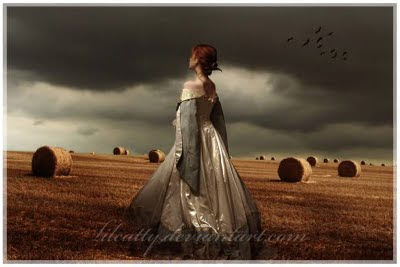
Lammas, by lilcatty on deviantart.comIn the Irish Celtic tradition, this festival is Lughnasadh. Here's a bit from Chalice Centre for Celtic Spirituality and Western Inner Traditions:
The Celtic harvest festival on August 1st takes its name from the Irish god Lugh, one of the chief gods of the Tuatha De Danann, giving us Lughnasadh in Ireland, Lunasdál in Scotland, and Laa Luanys in the Isle of Man. (In Wales, this time is known simply as Gwl Awst, the August Feast.)

Lugh dedicated this festival to his foster-mother, Tailtiu, the last queen of the Fir Bolg, who died from exhaustion after clearing a great forest so that the land could be cultivated. When the men of Ireland gathered at her death-bed, she told them to hold funeral games in her honor. As long as they were held, she prophesied Ireland would not be without song.

Tailtiu’s name is from Old Celtic Talantiu, "The Great One of the Earth," suggesting she may originally have been a personification of the land itself, like so many Irish goddesses.

In fact, Lughnasadh has an older name, Brón Trogain, which refers to the painful labor of childbirth. For at this time of year, the earth gives birth to her first fruits so that her children might live.
Domi, one of my long-time Crone Thread friends, wrote the following reminder, in response to "The Dark, again":
Lughnasadh is a funeral—that's what Nasadh means, the funeral assembly of Lugh for his foster mother, during the nine days of the barley-harvest.

As we gather in the life-sustaining grain we hold the funeral games and feast, that Lugh consider her sufficiently remembered and honoured and not in his grief and rage manifest as storm-god and destroy the rest of the harvest before we can gather it all in.
This helps Walhydra to make sense of her August 1st experience each year, namely, her awareness of the "thinning of the veil."

Because it reminds Walhydra that around August 1st is the beginning of harvest. And for as long as humankind has relied upon the gift of cultivation, humankind has known that harvest is the beginning of the dying time of year.

The Earth gives her body to give us food.

We celebrate her funeral with games and dance and feast.

Knowing that we, too, will die and go back to the Earth.

Thank you, Domi,

and to all of you,
Blessed Be.


Note: Brian Friel wrote a play, Dancing at Lughnasa, which was made into a movie in 1998.

Saturday, October 03, 2009

The Dark, again

Walhydra notices something a bit different about the onset of The Dark this year.

Thank Goddess, it's not the psychotic rollercoaster ride of two years ago, when chronic depression actually overthrew Walhydra's homeostatic whosiwhatsis, so that her brain couldn't keep the serotonins in balance. It's also not the long slow decline into the fat-fed lethargy of Winter Solstice holidays...not yet, anyway.

Instead, what Walhydra is gradually becoming aware of is an uncomfortable sense of transparency.

"No, I don't mean that I can see through myself," Walhydra snorts. "It's just that I can...well...see through myself…and others...."

Let's backtrack a bit.

Walhydra tends to get her first annual glimpse of The Dark around Lammas Day, August 1st, the old English festival of first harvest.

Autumn Equinox, by Carol WiebeShe knows that the modern calendar considers Summer Solstice to be the beginning of summer, which would make Lammas mid-summer's day.

For some time, though, it has been at Lammas that Walhydra senses the first whiff of autumn in the air…just as at Candlemas (aka Imbolc, aka Groundhog's Day, aka February 2nd) she senses the first whiff of spring.

After a few years of experiencing this backwards shifting of "whiffs" through the cycle of the seasons, Walhydra finally decided just to go with it.

Now she starts counting autumn from Lammas, with second harvest at Fall Equinox as "high autumn," and third harvest at Hallowe'en (aka Samhain) as the first whiff of winter.

Somehow this widdershins shifting of the seasons helps Walhydra to be better prepared for their changes, better prepared to watch for their subtleties and complexities.

Anyway, this year at Lammastide Walhydra noticed not just the first whiff of autumn. She noticed the "thinning of the veil" between the living and the dead, which Pagan tradition places at Samhain, half a year later. Granted, it took a month or so for her to realize that this was what she had sensed, yet by now the message is clear.

The message isn't an apocalyptic, end-of-the-world kind of message. It is present-moment and down-to-earth.

We are all mortal…now.

The veil between the living and the dead is our own bodies. They are always thin, and they grow thinner by the moment.

"What's going on here?" Walhydra laments.

Until two years ago, autumn had always been Walhydra's favorite season. She loves the crisp air and the fall colors—although Florida…ahem…somewhat lacks the vast forests of autumn-covered hills of Walhydra's Ohio childhood.

Then came the serotonin crisis, actually a physiological over-response to the family crisis of moving Walhydra's mother, Senior Witch, to Florida and beginning the long process of selling Senior Witch's house from 300 miles away.

Last year, after Senior Witch had moved yet again to an assisted living facility (ALF) near Walhydra, there was no chemical or family crisis, yet the taste of autumn had become somewhat spoiled. Walhydra realized that her brainstem was reacting to the shorting days be deciding it was time to feel chilly and to anticipate grief.

This year, autumn has an added taste. Aside from the obvious seasonal changes, The Dark now brings with it a concrete and increasing sadness about mortality.

"But it's not just sadness about mortality," Walhydra explains in a somewhat subdued tone. "It's mortality itself, which feels very real this year. Not just a notion, not just an abstraction from a fact to be dealt with...eventually."

It isn't fear of mortality, either. It's simply knowledge.

"We are all running up against actual, irreversible limits," she says. "It's a basic, visceral reality."

Four Saturdays ago, Walhydra and Hubby Jim were called to the hospital at 2 AM. Senior Witch had fallen in her bathroom. She got nine stitches in her right temple and had to have a huge flap of fragile skin taped back in place on the back of her right hand.

No concussion, no broken bones, so, fortunately, not a major fall. In fact, Walhydra watched bemused as this steadily shrinking old lady joked with the ER doctor about "my poor, ugly hand" and rebounded by lunchtime the same day to gossip with her friends at the lunch table.

But…Senior Witch has clearly moved into the childlike phase of Alzheimer's.

She still remembers people. She is still that sweet person who charms everyone she meets. She still sometimes summons the mental focus for brilliant conversation.

Usually, though, she takes a child's approach, making up explanations and excuses for troubling things that happen…including that fall. And she rewrites her own history, free-associating different real and imagined details to account for events…including that fall.

She is unlearning. The likelihood of teaching her new safety steps is questionable.

In response, Walhydra has had to drag her clinical social worker persona out of mothballs to deal with crisis and follow-up issues with emergency room staff and with ALF resident care administrators.

The certain knowledge of mortality hit home about a week or so after Senior Witch's fall.

This was when each next story of hurt or loss, a bombing in Pakistan or a shooting in the US or a library colleague's family illness or…whatever, became not just another story but visceral evidence that we are fragile, irreplaceable animals with an irreversible mortality.

And the sadness....

Walhydra has begun waking up each morning in sadness. Not the crazy sadness of brain chemistry imbalance, but base-line racial sadness.

She gets booted back into consciousness at 4:30, 5:30, 6:00 in the morning. Staggers into the living room to do some sort of imitation of tai chi and meditation. Flees from the over-focus of meditation back to the bedroom to clasp herself against the warmth of Hubby Jim...who dutifully rolls into playing spoons, even in his sleep.

And stifles the temptation to descend into a serotonin-exhausted grief because she knows that Jim, too, will age and die.

Last weekend, Walhydra took a long overdue trip back to her home in Columbia, SC, to spend a Friday evening with her longest-known and best friend there, and Saturday and Sunday with her father, the Lutheran preacher, and his second wife.

The visit with her friend, whom Walhydra considers her senior Virgo mentor and technology guru, was excellent, as always. It's a relief to escape the mundane world into the saner company another Virgo practitioner.

[Note from the amanuensis: "The power of accurate observation is commonly called cynicism by those who have not got it." George Bernard Shaw, Irish dramatist & socialist (1856–1950)...a Leo, but it's the thought that counts.]

The visit with Walhydra's father had a peculiar, frustrating grace.

Her father has Parkinson's. It makes him mumble so much he's difficult to talk with...this man who's been a preacher and teacher for most of his eighty-some years. It makes his handwriting tiny. He's feeble and shrunk down to nothing and bruised and bored.

For decades, Walhydra has struggled with a compounded version of the classic eldest-son's resentment of and distrust toward his father. Despite—or maybe because of—both of them being gentle, sensitive, articulate men, the father-son misconnections of patriarchal cultures have all been painfully present.

All of that was compounded further by Walhydra's being in the closet her first twenty-some years. Compounded yet again by her father's having left Senior Witch for another woman, back in the late1970s.

Still, over the past decade, both Walhydra and her father have been graced with what forgiveness is often really about: the ability to willingly forget past sins.

"It's too important to be together now," Walhydra explains.

"I'll never get an acknowledgement from him of all his 'crimes'...or, most likely, be able to give him my own acknowledgements. But I don't need that any more in order to be okay with myself. What I need is just to be with him in the present."

So that's what they did.

They sat together watching hours of Saturday football.

[Patriarchal culture's ultimate irony: two peaceable men, bonding...as best they can, since they can't speak...by watching other men fight.]

They listened to her stepmother's parrots and cockatoos and canaries talking and making noise out on the sunporch. They shopped for groceries. They had silent meals together.

And talked as much as they could manage...which, though painfully spare, was enough.

On Sunday morning, Walhydra's father cooked lunch and then forced himself to a level of articulateness, in order to speak briefly about how his parents lived into their late eighties, and how his eldest brother is now in his nineties.

"I guess I've got a few more years left," he smiled. They both smiled, Walhydra feeling the hollowness grow behind her solar plexus.

They stood and shared one of the longest, warmest, best hugs they've shared in years.

And, when Walhydra finally let go...her father collapsed backwards like a tree and landed up against the kitchen cupboards.

"Dad! Dad!" Walhydra knelt in front of him with her hand behind his neck, supporting his head.

He looked dazed, then his eyes cleared, and he said, "I'm all right. I'm all right. I sort of blanked out for a moment."

Once she sensed he was okay and had gotten him into his armchair in the den, Walhydra went for her stepmother.

"Did he hit his head?" Stepmother asked.

"Yes."

"Where?"

Walhydra put her hand behind the top of her head.

"Oh. Well, then, he's all right."

Walhydra stared in confusion, used to yet still startled by Stepmother's blunt, practical manner.

"He has a hard head. As long as he didn't hit the bottom of his skull...."

"Oh."

Stepmother spoke to Dad and checked his blood pressure.

The two of them laughed if off, to Walhydra's dismay...though at some level she trusted their humor.

"Did I scare you?" Dad asked.

"I think you hugged him too hard," Stepmother said. "It might have impeded the flow of blood to his brain."

Walhydra nodded blankly, knowing that they were not teasing her but, rather, witnessing to her their daily, moment-by-moment method of coping with...well...their age and mortality.

The three of them spent a while longer reassuring each other, hugging each other (gently), and saying their goodbyes. Then Walhydra got in her car for the long, boringly safe drive back to Florida.

"I hugged him too hard?" Walhydra wondered.

Decades of longing for closeness with a distant father whom she remembered having been very physically affectionate in her childhood. Decades of longing to talk with a private, withdrawn father who now was open to her but could not speak.

And the most affectionate hug they had shared in years—exaggerated, perhaps, by Walhydra's longing—had made him pass out.

"Who's writing this script?" Walhydra asked with tragicomic sarcasm.

Here, then, is how Walhydra is coming to understand her transparency, and the transparency of everyone who crosses her path.

"We are mortal for every moment of our existence," she says. "And, for now, I'm seeing that...not in every moment, yet often.

"We are so fragile. Anything could tear the veil. Yet we stay alive...for a while."

Walhydra imagines a different reading on the Garden of Eden story.

She knows—as many people tend to forget—that Adam and Eve were created mortal, the same as all the other animals. Death is not a punishment. It is merely part of the Creation, about which the Divine One said, "It is good."

But when they ate that apple, suddenly they knew they were mortal, unlike any of the other animals.

The rest is show business.

Now, whenever someone does something that annoys or distresses or angers Walhydra, something stupid or selfish or inattentive...or...or....

Whenever that happens, Walhydra realizes, "Oh, he's mortal. That's his way of trying to cope with or deny his mortality at this moment."

That's how people have become transparent to Walhydra.

Well, maybe not "whenever," of course. Walhydra's own avoidance/denial habits tend to keep her in resentful curmudgeon mode—or, more kindly, in struggling human mode—much of the time.

That's how Walhydra has become more transparent to herself.

It all doesn't feel good...or maybe it sort of does. Like it sort of feels good when you fall backwards, crashing your head against a cabinet door, and then the pain at the back of your head starts to mellow and feel a bit warm.

Seeing in The Dark.

And so it is.

Blessèd Be.

Sunday, December 28, 2008

Yule blood

First sliver of New Wolf Moon, after Winter Solstice

Walhydra realizes that "blood" is not a word folks usually associate with Yule. We usually think of lights and worship and music and family...and scurry and worry and spending too much and eating too much....

Red BowEven so, on Yuletide morning, Walhydra marked her black front door with a splash of blood-red ribbon.

It was as if she were making certain that the angel of midwinter darkness would pass over their home and allow the first born light of the New Year to shine upon them.

Not that Walhydra is troubled by darkness this year, as she was so profoundly last year.

Unlike then, Senior Witch now lives just fifteen minutes away, in a comfortable, competently staffed assisted living facility. Walhydra and Hubby Jim see her now as often as they did when the three of them still lived in South Carolina.

And Walhydra has been able to resume adult conversations with the brilliant woman who still peeks out with determination through the increasing childlikeness of Alzheimer's.

This winter's darkness has been filled with cozy slumber and cuddling with Hubby Jim, rather than with the neurochemistry-driven despair and panic of a year ago.

At first, back between Samhain and Thanksgiving, Walhydra was scolding herself for neglecting completely the dawn ritual which kept her marginally sane last winter: the floor exercises and tai chi, the zazen, the devotional reading and prayer.

As the days grew shorter—"As I had to start going to work in the dark and coming home in the dark!" Walhydra points out—it became increasingly tempting to just stay in bed, snuggling with JimJim until the last possible moment.

It was quite a challenge to her "dark Lutheran" sense of duty. "I ought to be disciplining myself to get up on time," she would say, using Senior Witch's favorite Lutheran preacher's kid term of self-abuse.

Eventually, though, Walhydra was rescued by a long-time online friend Igraine, who assured her that playing spoons was a perfectly marvelous way to get through the winter months.

In any event, why is Walhydra speaking about blood in relation to Yule?

Isn't the season of Chris-Hanuk-Kwanzaa (as Jim calls it) about good cheer and overly sweet desserts and candles and garishly colored, blinking lights on houses and yards....

"...and little girls dancing to that cutesy, overwrought Russian ballet," Walhydra adds, never having understood the obligatory annual repetition of this confection, which didn't appeal to her little boy self.

For years, Walhydra has felt that the whole winter solstice business is exploited and trivialized by modern American culture. Part of what a friend of hers calls the "santa-claus-ization" of sacred days and heroes.

Before the West invented the so-called infrastructure, with its piped-in water and gas and its wired-in electricity—and especially before cities allowed surplus people to huddle together for warmth and shared agricultural stores—Yule was not necessarily a friendly, cozy season.

It still isn't for the impoverished majority of the world.

At midwinter, the hope of the clan was that the hunters would drag back enough bloody meat from the forest to replace the dwindling grains and fruits and nuts of the harvest.

That was the red on the cloak of Father Yule. The blood.

Yule was for Herne, protector of all animal life, yet also lord of the wild hunt. Lord of "mortality, the body, sex, sweat, and being," as Walhydra's friend Cat once described him.

The other blood of the season is woman's blood. No babe is born without blood and the danger of death.

Yet the Christ Child, the Son of the New Year, is always presented to us in sanitized swaddling clothes—as if born from stirrups and epidural anesthesia in a modern hospital, swabbed antiseptically and laid clean on the new mother's breast.

This year, though, with Christmas coming in the midst of a global economic crash, it's the first time in decades that Walhydra has sensed a collective awareness of the finiteness of life. Of the importance of nurturing and conserving what we already have, rather than recklessly consuming the future.

We may be starting to remember that the ancient Yule was about survival.

Maybe our family—at least the hardiest of us—will survive until spring.

Maybe if we hunker down, lay on some fat and sleep a lot, relying on our brutal men to plod home with meat and our ragged women to live through childbirth...maybe enough of us will survive to go on.

Prosperous Westerners who pay attention to the Bible tend to gloss over the bits about blood.

The steps of the altar in the Temple were gushing with it.

The whole Middle World, Semite and Aryan alike—Philistine, Jew, Greek and Roman—relied on blood sacrifice to convince themselves that their gods would remember them in the worst of times.

In a similar way, those of us brought up in or under the sway of the Church are taught to make a big deal about Christ's blood as sacrifice to a god who demands such.

And yet....

Walhydra doesn't believe that the blood at Yule is about sacrifice, at least not about sacrifice as payment for sin.

It is about birth and food.

Yes, it is about death. About Herne's sacrifice of some of his children to feed others of his children. But not death demanded by a god.

Walhydra, convinced heretic that she is, takes Yeshua, the Christ Child, at his word when he quotes (Matt. 9:13b) Hosea quoting (Hos. 6:6) YHWH:

"I desire mercy, not sacrifice."
So where is Walhydra going with this sideways rant about the season? She isn't really sure. Putting that blood-red ribbon on her door got her to thinking, and that thinking is labyrinthine.

For example, she realizes that there is a third kind of blood at Yule, the blood which flows through us from generation to generation.

Lately, Senior Witch has been telling...and retelling...stories about her own parents. Walhydra has learned more about the character of her maternal grandparents in the past few months than she had during the past five decades.

In part this is Senior Witch's rehearsal for her own death, a process of letting go of the present and moving back into childhood.

Yet Senior Witch has a fiercely penetrating Sagittarian's perspective on her own life and the lives of her parents, husbands and children. She has always sought to string the bow of the past with animal intention and to aim it toward the future with spiritual wisdom.

Despite mixing up names and dates and sequences of events, Senior Witch can tell the hearts of her parents with a sharp yet compassionate precision. Walhydra realizes that she can do the same with her children.

It's daunting yet inspiring.

Also daunting is the word from Walhydra's father, the Lutheran preacher, at the dark of the moon. He called yesterday to say that his last sister had died. He alone survives his parents and five siblings.

Walhydra felt odd, longing to give reassurance to this man who has almost never dared ask for it, who has always done his sideways Cancerian scuttle to protect himself from self-disclosure.

Listening to her Dad's Parkinsonian mutter, Walhydra strains to sense what he is telling her, what he feels, what he longs for.

She gives him the most affirming um-hum's and uh-huh's she can...without knowing the content of most of this once eloquent preacher's sentences. She just wants him to know how much she loves him.

As best she can tell, that message gets through—and is returned in kind.

Wolf Moon.

Sliver of New Moon.

First week after Solstice.

It goes on. It goes on.

Winter Solstice sunrise at Newgrange - 19th December 2004
Thank the Divine One for the blood and the sun.

Blessèd Be.

Thursday, December 11, 2008

Oh. Um...yeah....

Goddess has been tapping Walhydra on the shoulder for several months now, saying *ahem, ahem* in her sweetest pretend-polite little voice.

Finally she has conked Walhydra on the head—in the friendliest way possible, of course.

"Um, Dear. You need to read this blog post."

The post to which Goddess refers is "The Dark," by Cat Chapin-Bishop, on the the blog she shares with her husband Peter Bishop, Quaker Pagan Reflections.

Cat writes:

It's dark, my friends. Yule is almost here, and the wheel is still turning....

Without the moon, the Dark is all there is.

Now, that's not a bad thing. Frightening to us sometimes, because we know Dark (we moderns) no better than we know Moon....

But, you know, you can walk a trail in the woods in the dark—in the full dark, the real dark, the dark without the moon—if your feet are wise, and if you know your way.

And you can deal with the dark, the growing dark, the Midwinter Dark, as our ancestors did, once upon a time.

How did our ancestors live, back in the days before electricity banished the darkness?...

Peter had read somewhere...a study of some group of humans...who lived communally, in a world without artificial light beyond firelight and the moon. And those who studied them noted how they dealt with the dark time of the year.

They slept. A lot.

Moderns are mainly sleep deprived. We nap, or sleep in for long hours when we vacation, but mainly, we do without. Unimaginable, then that entire groups of people would curl up and go to sleep when the sun's light fails. That, by five or six on a winter's night, whole families are at rest...and will stay so until six thirty or seven the next morning.

Except they don't. Sleep is different, it turns out, when it is not artificially staved off by lamplight, but allowed to run the full length of a winter's night. At times, it was more like a light doze, or a meditative wakefulness. And then, with little to divide it from waking, sleep would return again. People roamed in and out of dreams and waking several times each night. There was a different quality to it, not just a different quantity....
Cat then describes the experiment she and Peter did some years ago:
[To] the extent that we could, we decided to set aside the time between Yule and Imbolc--February 2nd--for the Dark. We would use no electric light, no computers, no television, no telephone except for emergencies, and no radio for that time. Oh, at work we would use such things, as we had need.... But to the extent we could, we did without them....

Whether it was the dimmer lighting, the quiet of a life without email and television, or simply ceasing the struggle against the Dark, we found ourselves aware of our sleepiness. We might not have gone to bed at seven, but we often were asleep by eight or nine.

It was good. The nights were soft, and the Dark was gentle.

And when, by Imbolc, the days were lengthening and the nights were growing shorter once again, we felt the returning light, in a way that's simply untranslatable unless you have also lived a season with the Dark. Each tiny sign of the return of spring--not the opening of the buds, but the swelling of them; not the disappearance of the snow, but the thinning of it, and the way it reflected the fire of the sunset later every evening--became pronounced.

This is the power of the Dark.
"Oh. Um...yeah...." Walhydra mumbles.

She realizes how much Cat's words speak to her condition.

"Yeah," Goddess murmurs, a little snidely. "I figured you'd notice that. You've not been paying much attention to body and spirit for a long time now."

"I haven't?"

"Um. You've stopped daily tai chi practice. You've stopped sitting meditation. You've stopped your morning prayers and devotional reading. You've stopped riding your bike...."

"Oh."

"You know, Dearest, that I'm all in favor of modern meds, within reason, but I'm beginning to wondering whether your SSRI experiment last November has gradually dulled your natural awareness?"

"Oh."

Now that she considers it, Walhydra realizes that she has gradually fallen out of the habit of all those deep self-care practices she was doing at the height of her grief-induced despair and anxiety last winter.

She didn't quit them as soon as she started to feel real again in February, when the meds had finally gotten her brain back to a healthy level of serotonin.

And it's not that she's stopped believing in the Divinely Real upon which those practices kept her focused.

But she sees in retrospect how, gradually, beneath conscious awareness, she has increasingly cut corners on herself..."because I'm too busy...because I've got to get to work...because I'm too tired...," etc., etc., etc.

Moon Over Half Dome, Ansel AdamsOn the other hand, since Fall Equinox, Walhydra has noticed Hubby Jim getting more and more cuddly at night and in the morning—and chosen to stay with him, rather than get up "on time."

It's so sweet, so full of good vibes, to stay huddled together under the covers. Playing spoons. Feeling the weight of the two cats, Sonic and Shadow, as they cuddle up...or bounce around wanting breakfast.

This exchange of cozy snoozefulness has increased as the days have gotten shorter. On non-work mornings, Walhydra lies in bed with JimJim for hours. Waking, deciding not to do tai chi, fading into sleep, waking....

About a decade ago, Walhydra realized that she no longer delights in fall and winter the way she used to. It took a few rounds of so-called "seasonal affective disorder" before she recognized that the shortening days definitely get her down.

At this time of year when everybody is "supposed to" be getting excited about the holidays, getting busier at work and at home, planning for family and parties and gifts and cards and....

Oy, veh!

At this time of year, Walhydra feels less than ever like being sociable and pretending to be nice to people (not a good thing for a public librarian). What she wants to do is hide out, eat, read and go to bed early.

A few years back she finally came up with a slogan for this, based on the same sort of anthropological and evolutionary biological studies Cat refers to:

"Between Samhain and Imbolc, our mammalian brainstems are trying to tell us to put on a layer of fat and hybernate until spring."

*sigh*

Goddess nods her head. "You see? I told you. Even though you know all this stuff, you haven't been paying attention to it. Again."

"Grrr...."

"Oh, don't grrr at me. You know I'm not into guilt-tripping. Just a friendly conk on the head."

Walhydra smiles reluctantly.

"Now, be a good girl and say 'Thank you' to Cat."

Thank you, Dearest Cat. Thank you for speaking in this great, unending, Meeting for Worship in cyberspace.

Love to you.

And to all the gentle readers.

And so it is.

Blessèd Be.