One of Walhydra's favorite satirists, Maureen Dowd, writes in the New York Times about our culture's fascination with all the different, fearful ways the world can end.
Feeling a little jittery, I called David Morrison, the senior scientist at NASA’s Ames Research Center in California, who answers questions online sent from the public to the Web site Ask an Astrobiologist.
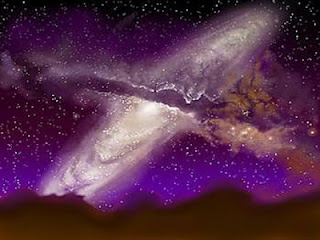
When Morrison finally had Maureen reassured that most of the fads about ends of the world are just that, "he mentioned that the Andromeda galaxy is going to crash into the Milky Way in two billion years."
This did not thrill Maureen, but Morrison said,
“We’ll just have twice as many stars.... The end of the world is a really silly concept. It’s been here for four billion years. I can imagine us blowing ourselves up as a civilization, but the planet wouldn’t care.”
How can he be sure?
“I have a doctorate in astronomy from Harvard,” he replied.
O.K. then.
At the library, we've been having a run on craziness.
Our usual population of mentally "off" customers have been way off. Our okay-but-weird customers have been way weird. And our regular customers have been short-tempered and demanding.
Since Friday the 18th, we've had almost a dozen incidents of over-the-top behavior which required intervention by our security staff—including several which required the local police.
Oy!
Only yesterday did I figure out—sort of—what's going on.
Sunday the 20th, there was a New Moon plus a Solar Eclipse plus the peak of a major, major Solar Storm: an astral trifecta!

Here's how Debra Campbell on RanchoSantaMariaPatch describes the effects:
Right now many under the influence of this celestial tug of war in May are feeling anxiety, mood deviations such as overwhelming sadness and apprehension switching to elation, inability to sleep, appetite changes, swelling or pain in the body, out-of-body type feelings, unusual dreams, dreams or visitations from people who have passed on, shifts of consciousness, bursts of creativity, visits or memories from past relationships, relationships difficulties, pain in the body especially in the muscles and joints, and irritable buzz and more.
Or...claiming that someone else is controling your computer and messing with the format of the law suit brief you are writing.
Or having a fist fight with your cousin over a bag or potato chips.
Or....
You get the picture.
We library-type people have been wondering, in the midst of this, how weirdly we must be acting. We can't tell, since, for the most part, we are (a) normally weird and (b) not as weird as the people around us this week.
So how long will this solar storm last?
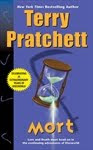
Back in September 2011, Walhydra was reading Mort, the fourth volume of Terry Pratchett's brilliant Discworld Series. (She thinks it's the fourth...time is weird on Discworld. She's already read The Color of Magic, The Light Fantastic, and Equal Rites.)
Walhydra likes pretty much everything about the Discworld books, but her favorite character so far is—surprise, surprise—Death. Or should we say DEATH, since he always speaks in upper case, without quotation marks? He always appears as a hooded, animated skeleton with glowing eyes.
What Walhydra admires most about Death is his attitude toward...um...death.
As far as Death is concerned, death is not some sort of evil consequence or punishment for mortals. It's just his job. All mortals die, and Death's job is to help them finish the business.
It's the mortals who, clinging to their lives, label death as "evil," as "punishment." Poor Death struggles with the unfair blame...though he always rises above it.
The title character in Mort is a young mortal whom Death takes on as an apprentice.
"Er," [Mort] began. "I don't have to die to get the job, do I?"
BEING DEAD IS NOT COMPULSORY.
"And...the bones...?"
NOT IF YOU DON'T WANT TO. (12-13)
Death leads Mort to the great twin city of Ankh-Morpork, where they stop for a meal at the Curry Garden. The place is crowded, "but only with the cream of society—at least, with those people who are found foating on the top and who, therefore, it's wisest to call the cream." (19)
Mort is puzzled by the fact that, besides himself, no one seems to see Death.
"Is it magic?" said Mort.
WHAT DO YOU THINK? said Death. AM I REALLY HERE, BOY?
"Yes," said Mort slowly. "I...I've watched people. They look at you but they don't see you, I think. You do something to their minds."
Death shook his head.
THEY DO IT ALL THEMSELVES, he said. THERE'S NO MAGIC. PEOPLE CAN'T SEE ME, THEY SIMPLY WON'T ALLOW THEMSELVES TO DO IT. UNTIL IT'S TIME, OF COURSE. WIZARDS CAN SEE ME, AND CATS. BUT YOUR AVERAGE HUMAN...NO, NEVER.
He blew a smoke ring at the sky, and added, STRANGE BUT TRUE. (20)
Pretty much sums it up.
And so it is.
Blessèd be.
Here is a beautiful portrait of Terry Pratchett and Death, done by Flynn-the-Cat and posted on DeviantArt and RedBubble.

Flynn's own commentary on the portrait:
A portrait of Terry Pratchett, his Death and his Discworld.
He's the creator of the Discworld, that little planet being carried away into space by the turtle Great A'Tuin, with the sun setting on it.
Death, the walking skeleton with an awful lot of character appears in all his books (however briefly) and spends a lot of time trying to figure people out. he's here because a) it's about dying (mental, age, possible-suicide), b) he's kinda a reflection of people (he is shaped by their expectations, so he's in mirror image to Pterry, c) he's one of Pterry's greater legacies, and d)... well, if anyone outlives the Discworld, it'll be Death.
The lilacs were worn in memory of a revolution in Night Watch and are now the symbol of Wear the Lilac Day on May 25th - Discworld Day, and now dedicated to Alzheimer's Awareness.
Because—oh yes, Terry Pratchett has Alzheimer's Disease. And I started painting this while listening to his documentary on assisted dying: Terry Pratchett: Choosing To Die.
Here's a link to a new Terry Pratchett interview on the Late, Late Show, and a link to an NPR interview in August 2011.
Terry's own website is here.