Friday, April 25, 2008

Free Will Astology

Walhydra's mostest favoritest astrologer is Rob Brezsny, who publishes Free Will Astology. This marvelous oracle appears each week online and in alternative newspapers everywhere.

The main reason Brezsny's work pleases Walhydra so much is that he only gives positive readings. Even when he's warning or correcting, he couches it in humorous, affirming, go-get'em language.

For example, here's Walhydra's Virgo reading for the week of April 24th:

Vertical Oracle Card 17The billboard I saw said, "Develop a recreational habit that won't show up in your urine."

I didn't catch what product it was advertising, but there was an image of a hang-glider, so I figure it was promoting outdoor sports as a preferable alternative to taking drugs.

The billboard message happens to be excellent advice for you, Virgo. In the coming weeks, you'll be wise to seek liberating adventure and explore new modes of natural fun.

Doing so will steer you away from a path that could lead to messy adventure and decadent fun.
Now how cool is that?!

BTW, Brezsny's website always links illustrations of cards from the Vertical Oracle with his readings.

Walhydra can't tell if there is significant synchronicity between the readings and the cards, or if it's just a random sort. But then, synchronicity
is random, isn't it?

Vertical Oracle is a rather odd yet fascinating alternative "tarot," which Walhydra just started looking at today. Hence, linking to it is not an endorsement...just a hint toward something neat to explore.
So, anyway....

When Walhydra gets utterly bored at Reference Desk toward the sloooow end of a long work week, she tends to drift around at random herself.

Once she remembered Brezsny, she of course had to Google him. The most interesting thing she found was Damon Orion's article, "Sign Language," in the January 31st issue of the Santa Cruz Good Times. Since she's being lazy anyway, Walhydra decided to quote from this guy, rather than write a real post herself.

Joking aside, it's exhilerating to read Brezsny's take on astrology and other oracles.
“I think astrology, at its best, is about opening up the imagination, opening up the possibilities, by getting you to play with visions of what’s possible,” Brezsny offers.

“It’s not a belief system; it’s not a religion; it’s not a science. It’s a language of the archetypes that you can play with and thereby get a read on the biggest possibilities that are available to you.”

But if Brezsny sees astrology as a symbolic language, then does he or doesn’t he literally believe that the planets have a say in earthly affairs?

“There are many astrologers who don’t believe that the planets literally shower down some sort of invisible influence on people,” he says. “I know that some astrologers believe that, but I would say that at this point, a majority don’t. The important thing is that the planets are signatures in the sky that can be read and have been read by experts over a number of centuries and correlated with specific tendencies in the human personality and in evolution.”

Brezsny points to a passage from what he calls “the definitive astrology book of the 21st century—probably the 20th century, too”: Richard Tarnas’ Cosmos and Psyche. Therein, Tarnas compares the motions of the planets to a clock:

When you look at a clock, you do so to know what time it is, but the clock doesn’t cause time. Likewise, when you’re reading the movements, configurations and relationships of the planets, you’re getting a read on the particular energy of a given moment, but the planets don’t cause that moment.

But if the planets aren’t influencing human behavior, then how, exactly, are these two things correlated?

“The theory of divination is that everything reflects everything else,” Brezsny states, “so that the tealeaves at the bottom of your tea cup are an exact reflection of the nature of this moment in civilization, or the way the Tarot cards are thrown down is an exact replica, if you know how to read it, of where we are now, or probably of where you are, if you’re throwing the cards. But the value of reading the heavens as opposed to tealeaves is an objectively existing thing: It’s very objective and can be traced into the distant past and the distant future.”

Brezsny adds that it’s a well-established tradition in human societies to read any number of natural signs for clues to the inner nature of things. He mentions that San Francisco Chronicle columnist Tom Stienstra makes long-term weather forecasts by analyzing natural phenomena such as the quality of red onion skins. Stienstra can also supposedly tell what the spring is going to be like by the thickness of the winter coats on coyotes.

Breznsy also mentions that when acacia flowers are ready to bloom, members of an Australian tribe called the Yanyuwa know that the sea turtles and the dugongs (a kind of marine mammal) are getting fat and are therefore ready to be hunted.

“So they’re reading the signs of nature to make some sort of deductions about what’s to come,” he says. “And I think astrology is exactly that. There is a well mapped out understanding of where the planets were thousands of years back and where they’ll be thousands of years into the future.”

And what are we to make of the notion that human behavior is connected with planetary positioning at the time a person is born? What is so crucial about the moment of birth, and how are the planets connected to this?

Brezsny refers to a person’s astrological chart as “a snapshot of the archetypes at that moment.” He says that although the tradition of astrology has developed based on a person’s birth, at any particular moment, we could take this kind of snapshot of the heavens to get an idea of how the archetypes are working together to create human civilization.

“Conceivably, there could have been a tradition that developed over many centuries that involved the analysis of where the planets were at the time of conception,” the astrologer says, “but that’s a much murkier thing. It’s very easy to know when a person is born. It’s a very dramatic event. So the tradition grew up around what was the snapshot of the heavens at the moment the person was born, and over centuries, many people have devoted their life energy to trying to make empirical observations about what kind of pictures of the heavens are correlated with particular human types.”
Woof! Beautiful!

And so it is.

Blessèd Be.

Thursday, April 24, 2008

No h'aitch

Walhydra was LOL at lunch today, reading some choice dialog between folks of diverse dialect in the British Isles, from Dorothy Sayers' The Five Red Herrings:
"Nae doot," pursued the Inspector, "if Mr. Gowan were at hame, he wad be anxious tae gie us a' the assistance in his power."

The butler was sure that Mr. Gowan would be only too happy to do so.

The Inspector opened his notebook.

"Your name is Halcock, is't no?" he began.

The butler corrected him.

"H'alcock," he said, reprovingly.

"H, a, double-l?" suggested the Inspector.

"There is no h'aitch in the name, young man. H'ay is the first letter, and there is h'only one h'ell."

"I beg your pardon," said the Inspector.

"Granted," said Mr. Alcock.

"Weel, noo, Mr. Alcock, juist a pure formality, ye understand, whit time did Mr. Gowan leave Kirkcudbright on Monday nicht?"

"It would be shortly after h'eight."

"Whae drove him?"

"Hammond, the chauffeur."

"Ammond?" said the Inspector.

"Hammond," said the butler, with dignity. "H'albert Hammond is his name—with a h'aitch."

"I beg your pardon," said the Inspector.

"Granted," said Mr. Alcock. "Perhaps you would wish to speak to Hammond?

"Presently," said the Inspector.
Hammond, it turns out, speaks cockney dialect, so there's even more misunderstanding to follow.

Of course, unlike in the British Isles, we all speak the same here, don't we?

Y'all come back now, y'hear?

Tuesday, April 22, 2008

Hafiz, again

Walhydra was looking this morning for something she could use to comfort her brilliant brother and his wife and son, all of whom are going through major challenges.

She wasn't surprised to find it here:

You Were Brave in that Holy War

You have done well
In the contest of madness.

You were brave in that holy war.

You have all the honorable wounds
Of one who has tried to find love
Where the Beautiful Bird
Does not drink.

May I speak to you
Like we are close
And locked away together?
Once I found a stray kitten
And I used to soak my fingers
In warm milk;

It came to think I was five mothers
On one hand.

Wayfarer,
Why not rest your tired body?
Lean back and close your eyes.

Come morning
I will kneel by your side and feed you.
I will so gently
Spread open your mouth
And let you taste something of my
Sacred mind and life.

Surely
There is something wrong
With your ideas of
God

O, surely there is something wrong
With your ideas of
God

If you think
Our Beloved would not be so
Tender.

The Gift: Poems by Hafiz the great Sufi Master
translated by Daniel Ladinsky

And so it is.

Blessèd Be.

Sunday, April 13, 2008

So who is this "Bright Cow," anyway?

Walhydra likes to tease her amanuensis about a typo he makes occasionally with his totem name, Bright Crow.

Since he's been typing for forty years, often to earn a living, he just shrugs and laughs. Nonetheless, she thinks the question her title asks is worth exploring.

Now Walhydra herself refuses to explain to anyone what her name means, but it does have a sort of folk etymology.

Back in another century, Walhydra was working as a male secretary for an international construction project in Saudi Arabia. That's where she met Nikki, Husband #3 (JimJim is #4).

Nikki is a gifted and humorous witchy fellow from the Isle of Wight. For the several years that he and Walhydra worked and traveled together, they constantly shared their fiction writing with each other.

Nikki had a properly British muse, yet he insisted that Walhydra had to have two, to whom he gave suitably Teutonic names: Waltrot and Hydrant. As the writing partnership progressed, it was decided that Waltrot was responsible for all the Sturm und Drang, while Hydrant wrote the comedy and the "gushy bits."

Fast-forward fourteen years or so to the mid-1990s. Walhydra was now writing as part of several Pagan, Gay, Christian and All-of-the-above chat rooms and discussion boards on the Web, using the screen name of her amanuensis.

At some point, a wise witch invited Walhydra and several dozen others to leave the chat rooms for a private, flame war-free listserv of mostly Pagan, mostly women elders. These are all folk who revere and emulate the Crone aspect of the Goddess.

Somehow, when the amanuensis began writing comic, autobiographical stories for this dear online circle of friends, Walhydra sprang full-grown—by a sort of spiritual parthenogenesis—from some probably unprintable union of Waltrot and Hydrant.

Around this same time, in the course of changing Internet service providers, the amanuensis was casting about for a new email/screen name.

That was when years of dream journaling, fantasy writing and attending to the confounding yet salutary links between outer and inner world imagery yielded up the Bright Crow totem name.

"Oh, I get it," says Walhydra, rather smarmily. "A clever, squawking bird who's good at mimicry and eats carrion or steals hatchlings from their nests for food."

Always willing to annoy Walhydra for the fun of it, the amanuensis nods. "Yeah, that too."

He knows that the name actually has much richer though more ambiguous significance than this. Of course, those deeper meanings can only be hinted at through storytelling.

There are early clues in a story fragment he wrote in Arabia, just before his twenty-ninth birthday.
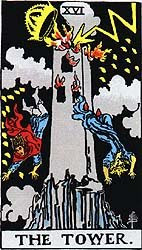
Waite Deck, The Tower
An unnamed figure climbs the stairs of a milky white, marble tower and steps into a burned out chamber, the outer wall of which had been blasted away ages ago by arcane fire.

Crows swoop and laugh as he looks out over endless green lawns and hills to the north, and, to the south, "scorched black ruins, stumps and fire-charred shrubs, and hard, cracked earth."

Soon there follows this passage:

Yet again the crows laughed.

"Are you dead yet?" they asked—not with sneers, but with something vacant and cold in their voices. Their laughter was vibrant, inhuman, devoid of emotion.

He smiled and raised up a hand, where a small stone lay in the crease of his palm. The sun caught its ruby heart, and it gleamed with a laugh of its own. The crows flew away.
"So," Walhydra observes. "The good old 'harbinger of death and destruction' crow."

"Well, yes," the amanuensis replies without apology. "A novice Lutheran shaman might perceive them that way."

"Huh?"

"You know. Europeans spent centuries killing each other off with famine, plague and war, all the time carrying the Cross in front of them. As if death were a punishment meted out by the righteous on the unrighteous."

"So crows...?"

"...were omens of death as retribution for evil—or as the victory of evil itself."

"And since everybody dies...?"

The amanuensis smiles silently.

"I hate when you do that!"

The tower and the crows figured again in later story fragments during the early 1980s. After that they faded into a writer's archive as Walhydra began her fifteen-year career counseling addicts, sex offenders and mentally ill prison inmates.

Then death changed.

In the late 1980s, Walhydra's step-father of only five years died rapidly from cancer.

This wry, taciturn man had enabled Walhydra's mother, Senior Witch, to heal herself of decades of hurt. Then, in the space of four months, he went through several rounds of chemotherapy and relapse, sought out and made amends with everyone he'd hurt or been hurt by, and died quietly while Senior Witch slept in a chair next to his bed.

Next, Walhydra volunteered as an AIDS buddy for a thirty-year-old named Richie, who told her when they first met, "I've already had my argument with God. He's told me who's going to meet me on the other side, so I'm ready to go. But...," he looked around the room, "my friends aren't ready yet."

A year later, Richie came home by choice from one too many hospital trips for rehydration and tube-feeding. To everyone's surprise he was still living after a month, despite receiving nothing except morphine drip for pain.

One morning Richie came out of his drug fog...he'd been claiming he and his friends were all sitting at card tables on the roof playing bridge...and said, "Tell me what's happening to my body."

They told him about the scarcely breathing skeleton.

"What's today's date?"

They told him.

"My birthday is Tuesday. I want a party and a cookout."

Two dozen people met at Richie's home the next week—some of them for the first time. Friends from Richie's old home in New Orleans had FedEx-ed a daubache torte. They brought the cake with candles and balloons into Richie's bedroom and sang Happy Birthday to the grinning skeleton.

Then he spoke to each one privately. To Walhydra he said, "Your work is done now. Thank you."

He died two days later, having said nothing more after that night.

Walhydra sits back in her chair, remembering.

"And then there was Alex, who hated my using the term 'sex offender,' because he said if it hadn't been for older men teaching him how to make love as a teenager, he would have lived a miserable life. He got to dance in full regalia with his tribe at one last powwow in North Carolina, before AIDS took him at fifty."

She shakes her head.

"Then there was Luther, our best friend Randy's lover. That was the first time I actually saw someone take his last breath.... And I just remembered! My Mom was there with us!"

"Yes," says the amanuensis.

"But, where are the crows in all of this?"

Jamie Sams, Crow Medicine Card"Crow is shimmering, iridescent black in this world, because his feathers absorb all light. But on the other side, he gleams as bright as light."

"Oh. Bright Crow."

"Yes," says Bright Crow. "Death isn't an evil. It just happens. If anything is evil, it's the hurt we all do to ourselves and to each other in order to pretend that we are escaping death."

"Oh."

"That's why, whenever I hear a crow caw, I turn toward it, touch brow, lips and heart, and say, Blessèd Be'."

"...?"

"Because it is saying to me, 'Don't worry. You're just mortal. You don't have to figure out how to survive all of this.'

"It's saying, 'Just do the best you can for everyone at the moment. Then forgive and ask for forgiveness."

"Oh."

And so it is.

Blessèd Be.

Note: One way to consider the Crone is as that aspect of the Divine which, in the form of a wise woman past childbearing age, strives on behalf of her people to learn about and teach the terrors and blessings of mortality.

She does this by facing them honestly, walking through them with eyes open, breathing deeply, and returning to tell the tale.

Mary at the cross and Easter tomb of her son is one of Walhydra's examples. Another is Mother Teresa. Green Tara is a third.