Walhydra knows that there is a dark side to that latest story about her mother, Senior Witch.
"I thought that was the dark side," the gentle reader might be wondering.
"Well, yeah," a somewhat subdued Walhydra replies. "It wasn't the cheeriest of tales, was it then?"
She glances around awkwardly.
"But you see, Mom put her finger right on the sore spot. Remember what she said?
" 'For years I've been telling myself I was going to die perfectly healthy.' "
Walhydra isn't laughing.
This week Walhydra read straight through a weirdly brilliant "young adult" novel called I Am the Messenger, by award-winning Australian thirty-year-old Marcus Zusak. She recognized him from the very first pages as one of those youngsters who is "wise beyond his years."
Granted, going all the way back to childhood, a now rather envious Walhydra has liked to think of herself as "wise beyond her years." Unfortunately, since she never liked to be caught out speaking in error, she mostly kept it to herself—unlike this young genius. Now she suspects her years are beyond her wisdom.
In any event, at a pivotal moment in Zusak's novel, his first person narrator Ed says the following:
It's impeccable how brutal the truth can be at times. You can only admire it.
Usually, we walk around constantly believing ourselves. "I'm okay," we say. "I'm all right." But sometimes the truth arrives on you, and you can't get it off. That's when you realize that sometimes it isn't even an answer—it's a question. Even now, I wonder how much of my life is convinced.
I get to my feet and join [my friend] Ritchie in the river.
We both stand there, knee-deep in water, and the truth has well and truly pulled our pants down.
The river rushes by. (304)
Walhydra has had her own pants down for much of this same week. Unproductively, so to speak.
As part of her diligent Virgo program of "dying perfectly healthy," a year ago she joined the local taoist tai chi class. It's actually made noteworthy difference to her in terms of limbering up her posture and unkinking fifty-mumble years' worth of asymmetrically stored psychosomatic stress.
Joking aside, she seriously recommends this practice.
Nonetheless, it doesn't make incarnate the Virgo fantasy of returning an old body to its unblemished and divine wholeness. Darn.
Instead, what the practice does do is to give one a template towards which to aspire.
What delights and fascinates Walhydra is this. This far along with her practice it will happen that, at any given moment, walking, standing, sitting, driving, her body will notice miniscule misalignments—a left shoulder slightly raised, a right psoas muscle failing to release enough to square her hips—and will make the correction as best as the ancient nerves and muscles can.
"Ancient?!" Walhydra objects, seizing the fountain pen from the hand of her amanuensis. "Just write what I tell you. Don't editorialize!"
The point is that tai chi is slowly restoring a bone-deep body sense which Walhydra has known only sporadically since her bout with non-paralytic polio at age four. This gives her hope.
But about that dark side.
Two Saturday's ago, Walhydra joined her class for a day-long intensive workshop. Despite the sound of that word "intensive," it was a pleasant day of gentle, deep-muscle workout and friendly socializing—until it was followed by a long night of aching, groaning, upset stomach and cramping bowels.
"Oh," Walhydra said in the pre-dawn darkness. "That's right. This is Chinese 'alternative medicine' exercise, releasing old toxins into the blood stream. I need to hydrate!"
Four days of hydrating later, four days of unproductive pants-dropping—despite doses of the liquid chalk some wag cleverly misnamed milk of magnesia—and Walhydra is saying, "Somethin' ain't right!"
She makes a doctor's appointment for Friday.
On Thursday night, Walhydra and hubby Jim are out for dinner with four of their fifty-something gay bowling league buddies. And they're all joking about it!
When she heads for the men's room at one point, Walhydra taps the guy next to her and says, "It's not the emergency you feared sitting in the way of. More likely just wishful thinking."
Upon her return—unproductive again—she asks her fellow geezers, "Did any of you think in your 20s that you'd be joking about stuff like this in your 50s?"
All shake their heads no, sobered by this strange, privileged camaraderie of having lived longer than most of the human race and yet still being prosperous and active.
Privately, Walhydra's Pagan buddy in the group says, "I wonder if it's all the grief and sh-t about your Mom that you're not yet able to let go of?"
Walhydra nods. "I've thought of that. It's bound to be part of what's going on."
But it's not only grief and sh-t about Senior Witch. Walhydra can't keep denying that she is older, too.
Yeah, tai chi is loosening things up for her—well, some things. Yet when she watches the progression of her Mom's failing memory, she's also aware of her own. And the doctor has been warning her about her not-yet-diabetic-but-rising blood sugar level. And the dentist wants her to cap the forty-year-old filled molar and the yellowed, root-canalled eye tooth.
For decades, Walhydra has been secretly delighted that people routinely mistake her from at least ten years younger than she is. During her prison counselor years she used to joke that she grew the goatee "because that's the only place I get gray hairs—and I've earned them."
But, as the Chiffon commercial used to say....
When Walhydra was making one of her recent lone trips to South Carolina, before Senior Witch moved to Pensacola, she stopped near Savannah for a pancake lunch. Browsing the menu, she realized she wasn't really up to eating five pancakes. Then she turned to the back page.
"Perkin's '55 Plus'!" it read. Three pancakes for the senior citizens' price.
"Hmm...," she thought bemusedly. And, like the baby bear's—or maybe grampa bear's—portion, it was just right.
Hmm....
On Friday, the physician's assistant finds nothing of concern in her physical exam of Walhydra's cramped up abdomen. An x-ray to rule out blockages finds nothing either. So the P.A. says to up the water and "milk" and fiber-rich foods...and wait.
That night things are—*phew!*--more productive.
At work on Saturday, Walhydra jokes with a soon-to-retire crony.
"By this age, I've learned to just laugh at my own psychosomatic ailments, instead of worrying about them," she says. "So I had to get the doctor's permission to start sh-tting again. Oh, well. It's silly, but it's a lot easier and quicker than psychoanalysis."
By this age?
Here, then, is the dark side. Trying to keep Senior Witch from aging and dying comes out of genuine fear of her loss. But someone else doesn't want to age or die either—despite her sometime enlightenment.
"If I could just eat the right diet, do this tai chi faithfully, get serious about cardiovascular workouts at the Y...."
Every once in a while, in the midst of her holier-than-thou rants, Walhydra acknowledges being a product of her culture's fears and fantasies, a mortal like all other mortals.
As she sat in Perkins eating that third pancake a couple months back, she thought about her chronic "fifty-mumble" joke. Then she tried out a different line, just to see what it would feel like.
"I'm almost sixty."
Hmm....
Walhydra realizes that she has created a dilemma for herself.
Well...actually she's created quite a few in her lifetime, but this one has to do with blogging.
The dilemma is this: How can she keep to her goal of writing nothing but sarcastic humor when, for much of the past few months, real life has tended to shut her down with grief and depression—disguised most often as a paralyzing sense of urgency?
"What?" the gentle reader exclaims. "You didn't tell us about that!"
"Of course not," Walhydra rejoins. "It isn't funny!"
As her amanuensis keeps pointing out, the constraints of satire censor out far too much of Walhydra's palpable human experience. She has to wait—especially after pain—until she can laugh about it, in order to be able to share it with her audience.
"So, what would you say?" she challenges him.
"I would say: I'm losing my mother.
"She's 83 and at least a year into early Alzheimer's. Last month, on extremely short notice because of a minor seizure, my siblings and I decided we had to uproot her from her home, church and neighborhood of forty years and move her to my sister's home, 600 miles away in Pensacola.
"I would say: She's still alive and safe. She's with family, with grandchildren, and putting the best face on it she can.
"But she's not the always-available best friend I've known most of my adult life. She's a sad, forgetful, disoriented refugee.
"And I can't take care of her the way I always have."
Long pause.
"Are you finished?" Walhydra asks, rather more meekly than she had intended.
"No," he says softly. "There's this: She can't take care of me anymore, either."
This is when both of them have to stop to deal with tight throats and tears.
Walhydra's usual manner, especially in crisis, is to be as professional as she can be.
Efficient social worker, doing triage. What's most important, right now, for Mom's safety and comfort? How do we get it done in the quickest, simplest way possible?
And then: How in the world do I deal with all these new financial and legal matters? With selling a house long distance? With supporting my angel of a sister as best I can? With keeping my loving brother up in Massachusetts in on the process?
With catching up on the job I've been away from for three weeks?!
All these responsibilities reel out before Walhydra, and she manages each as well as she can...at least until the crisis itself is past. Then she notices that there are all sorts of unfinished pieces lying around her—and that she has ground to a halt in an oddly numb panic.
Her sister shares a wise pastor's words: "Just do the next thing."
"But there are three dozen next things!" Walhydra cries. "Which next thing?"
After a few weeks of floundering and stalling—with, by grace, some genuine nurture from hubby Jim and friends at work and elsewhere—she notices another very quiet voice.
"The next thing, Dear, is to grieve."
"What...? Who...? Oh," Walhydra gradually realizes. "It's You. I wondered where You'd got to!"
An indulgent chuckle, like Spring brushing last year's leaves aside. "Silly old witch! You've been talking with me nonstop for weeks now."
"Oh, I know," Walhydra pouts. "I've been praying minute by minute for weeks now. 'Keep me in the present...help me center...guide my hand'."
"Yes, Dear," Goddess acknowledges. "You've been very courageous and faithful. But you haven't stopped. Except when you're unconscious in bed—and not even then."
She pauses.
"There's someone else you have to take care of besides your Mom."
"I don't have time."
"Um...."
Of course, Walhydra knows better.
In one of her earlier heart-to-hearts with her Mom, Senior Witch, she had steeled herself to say something out loud, allowing her sobs to come as she spoke.
"I've realized a way I've been fooling myself for the past few years. I've been pretending that if I just did a good enough job of managing things and providing for you, you wouldn't grow older and die."
Her mother hugged her, and they were quiet together for a while.
Then Senior Witch said, "I've realized something, too. I've realized that for years I've been telling myself that I was going to die perfectly healthy. Isn't that silly?"
They both laughed.
Goddess nods as Walhydra recalls the story.
"Yes," She says. "We have to keep reminding ourselves that we're mortal."
"Whadaya mean, 'we'?" Walhydra squints at Her a bit angrily.
Goddess just looks back, pretending to be inscrutable.
"My point is, you're allowed to be mortal. You're supposed to be mortal. You're not supposed to forget. It's when you forget that you play these hurtful games with yourselves and each other."
"But...but...."
"I know. It doesn't feel good. It's scary. It hurts."
"It hurts like hell!"
"Oh? No it doesn't." Goddess gives her Mona Lisa smile. "Not nearly that much."
Walhydra sits up, glaring. "You don't even believe in Hell! You claim it's something we made up to keep each other in line."
"I think you've changed the subject, Dear."
"Oh?"
"We were talking about you. Grieving. Or not wanting to."
"But I do...."
"Want to...?"
"No. Grieve."
"In your precise, Swiss-Lutheran-Virgo-Buddhist-Quaker-Witchy way."
"Stop teasing!"
Goddess holds her close for a while.
Late on the night of the day when Walhydra and her siblings decided they needed to move their mother, she and Senior Witch had said their goodnights and gone to bed.
Walhydra had tried to lay out the plan to her Mom, but only in a general sort of way. This was, after all, Senior Witch's first day home from hospital after the seizure, and she hadn't seemed all that well focused in the present.
Of course Walhydra couldn't sleep. She wandered into the darkened living room to try relaxation exercises and zazen. And of course her mind wouldn't stop.
But then it did.
And then the silence said: "You have to tell her what hurts."
Walhydra got up and walked toward her Mom's room, just as her Mom came out the door.
"I have to tell you...."
They went back to sit on Senior Witch's bed.
"I feel terrible that I'm...*sob*...taking you away from your home, after all this time of trying to keep you here."
Her Mom held her.
Then, "So, you're saying I have to move right away." A statement.
"Yes. Because of what we've been observing, what your friends have been observing, this past few weeks."
"Tell me what you've been observing."
Walhydra told her.
The constant forgetfulness. The losing of prescription meds in the wastebasket. The distress calls about minor problems which had already been resolved. The failure to feed herself well or even buy groceries.
"Then I have to move."
Walhydra marveled at the Senior Witch she remembered, back in the present for this crucial moment.
"Yes," she said.
They talked for a while, in love with each other, about how they managed to have such conversations. For years they had been adults with each other.
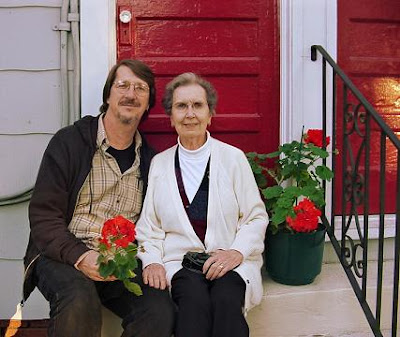
They had learned not to protect each other's feelings.
That is, they had learned that "I'm trying to protect her feelings" actually means "I'm trying to protect myself from her feelings, if I tell her how I feel."
Now they just talked.
"Do you remember," Walhydra asked, "back in September, when we went to rent a DVD that last night? You picked Iris, about Iris Murdoch's decent into Alzheimer's.
"And I kept wondering, all through the movie, 'Does Mom know this is what's happening to her? Is she trying to tell me something?' "
Senior Witch did her own Mona Lisa smile.
"I knew. And, no, I wasn't trying to tell you anything."
Walhydra looks up from her reverie at the Goddess.
"I feel like she's gone."
"Sometimes she is, Dear. Increasingly so. You can't bring her back."
They sit in silence.
"But you can keep talking to the Mother you remember. Keep writing to her. Even if she doesn't answer very well out of that body, out of that brain, she hears you."
"Don't get metaphysical on me, okay?!"
Walhydra doesn't like to admit how New Age-y even the most ancient religious assurances sound to her...or how much she wants to believe in them.
"Nothing meta- about it, Dear. We do hear you. Even if that body and brain are too tired to carry on much longer."
She stands and stretches, grinning in her usual, satisfied way.
"Just keep telling her, 'I love you.' That's enough."
And so it is.
Blessèd Be.
Walhydra is somehow managing to deal with the fact that her first mentor in benevolent cynicism has died.
She doesn't feel much like writing at the moment, but in tribute she has decided to post Verlyn Klinkenborg's Editorial Observer piece in today's New York Times:
If you read Kurt Vonnegut when you were young — read all there was of him, book after book as fast as you could the way so many of us did — you probably set him aside long ago. That’s the way it goes with writers we love when we’re young. It’s almost as though their books absorbed some part of our DNA while we were reading them, and rereading them means revisiting a version of ourselves we may no longer remember or trust.
Not that Vonnegut is mainly for the young. I’m sure there are plenty of people who think he is entirely unsuitable for readers under the age of disillusionment. But the time to read Vonnegut is just when you begin to suspect that the world is not what it appears to be. He is the indispensable footnote to everything everyone is trying to teach you, the footnote that pulls the rug out from under the established truths being so firmly avowed in the body of the text.
He is not only entertaining, he is electrocuting. You read him with enormous pleasure because he makes your hair stand on end. He says not only what no one is saying, but also what — as a mild young person — you know it is forbidden to say. No one nourishes the skepticism of the young like Vonnegut. In his world, decency is likelier to be rooted in skepticism than it is in the ardor of faith.
So you get older, and it’s been 20 or 30 years since you last read “Player Piano” or “Cat’s Cradle” or “Slaughterhouse-Five.” Vonnegut is not, now, somehow serious enough. You’ve entered that time of life when every hard truth has to be qualified by the sense of what you stand to lose. “It’s not that simple,” you find yourself saying a lot, and the train of thought that unfolds in your mind as you speak those words reeks of desperation.
And yet, somehow, the world seems more and more to have been written by Vonnegut and your life is now the footnote. Perhaps it is time to go back and revisit that earlier self, the one who seemed, for a while, so interwoven in the pages of those old paperbacks.
More to the point, here's a previously unpublished poem by Vonnegut, which the Times also posted today:
Worship
by Kurt Vonnegut
I don't know about you,
but I practice a disorganized religion.
I belong to an unholy disorder.
We call ourselves,
"Our Lady of Perpetual Astonishment."
You may have seen us praying
for love
on sidewalks outside the better
eating establishments
in all kinds of weather.
Blow us a kiss
upon arriving or departing,
and we will climax
simultaneously.
It can be quite a scene,
especially if it is raining
cats and dogs.
Such a dear, blesséd man!
And so it goes....


