No. Not to you, Dear Readers.
To all those millions of souls who have left us during the past year.
As Walhydra predicted earlier this month, she and hubby Jim did have four gay friends over for a Dumb Supper two nights ago.
Jim did his usual, marvelous "natural-born chef" routine, with butternut squash bisque, beef bourguignon and rice, broccoli polonaise and his own "secret recipe" maple walnut gingerbread, washed down with a Burgundy pinot noir and coffee. They set extra places for the Dear Departed—including a dish of "dessert" for Miso the Cat.
They spoke of Floyd (aka Mother), of Jim's Dad, of Miso. Of other family and friends, dead or parted by the years. They didn't dwell on death, but they recognized it.
Today, Walhydra wore to work her traditional Samhain garb: the black cotton crinkle cloth shirt, the labradorite pendant carving of a native Labradorite. She left the raven-headed walking stick at home, for fear of misplacing it.
She chuckled that all her librarian colleagues spontaneously chose plain black as well—though she wasn't sure about the one with the clerical collar or other in the nun's habit.
Walhydra recognizes that this Eve of All Hallows has indeed become a high holy day for her. As the days shorten, her body's attunement with the seasons reminds her of her own mortality. She watches her garden plants retreat. She watches her parents shrinking into their eighties. She notes the shimmering thinness of the world at twilight.
And she realizes—sans her usually sardonic humor—how seriously she takes the reality of death.
Walhydra doesn't mind the children's playfulness of trick-or-treat and silly costumes—or even the silly playfulness of the adults. But it troubles her a bit that the play has come to mask so completely the reality of death in our sanitary 21st century America.
We entertain our selves with death: comic death, action movie death, crime show death.
But we don't want to know about real death, war death, genocidal death, infant and child death.
Walhydra has become horrified at the way the media and political powers-that-be distract and titillate their audiences with Puritanical rants against "Halloween Vixens," while ignoring the thousands of global AIDS deaths which could have been prevented by informed condom use.
She knows what this dodge is all about, though. We are a people who really fear death. We fear it so much we don't even want to acknowledge that it exists.
Except as a Hollywood fantasy, in which heroes rebound from backbreaking falls to run and fight some more. Except as something that happens in the news (is it real or just “reality TV”?) to images of people in other countries...or of other sexualities, other religions, classes, races.
Except as something we can count—or refuse to count—and can weigh as a quantity to avenge or to exact in vengeance.
Walhydra doesn't feel like joking tonight, because she knows too much.
Because we, the so-called human race, have killed too many people this past year through violence or neglect.
In every case, she knows, we have killed because we have decided that our illusory safety is more important than those lives. Our illusory comfort and prosperity, our illusory religious and political superiority.
Because of our illusion that there is not enough to go around, which means we have the right to take and protect what we claim as ours.
Walhydra doesn't know how many people she herself has killed this past year with her careless comfort, but she knows the blood is on her hands.
However, Walhydra knows something else.
She knows that Mother Earth does not bring a soul into incarnation which She cannot feed and clothe and house and keep whole and loved. The only way one child goes without is that another has taken more than her share. The only reason one child leaves another in lack or loss or suffering is that she fears losing something of what she has.
Better still, Walhydra knows what her master, Jesus, taught her: That death is just something that happens to everyone.
Not a punishment for sin or fallenness. Not a separation either from loved ones or from Mother-Father God. Just a part of being a living creature.
That means dying—even just dying to something she wants, or to something she doesn’t want to share or to give up—is merely something that happens. Not a tragedy, a loss, a doom. It may be unpleasant, even extremely unpleasant. But merely something that happens.
And trying to avoid death—even if it’s just turning aside from a street person because she fears sharing that person’s lostness—is killing.
Walhydra definitely knows what Jesus meant by “being a slave to death.”
She also knows that the “freedom from death” Jesus shared and shares with his friends isn’t about not dying. It’s about not fearing.
So, tonight, Walhydra can chuckle at the trick-or-treat and costumes, the play-acting scariness, and so on.
But she directs her real laughter—her deep, sardonic witchy cackle—at the foolish, human way we make death into some ghoulish Other which will try to steal us. Worse, the way we make death into a barrier, a weapon, to hold up between ourselves and those others whom we fear will steal from us.
The only real death is the separation we impose between ourselves and others when we fear losing out to them.
Yet when we welcome them to our table, there is always enough.
And so it is. Blessèd Be.
Tuesday, October 31, 2006
Wednesday, October 25, 2006
Walhydra's salutary moment
Walhydra likes to believe that her nostalgia is not as tacky and self-deceptive as some people's.
*ahem*
She thinks back on her youth—sometime in another century—as a time when she and her peers were profoundly affected by the liberation movements and communal aspirations of their era. Not to mention their discovery of sex…and those other two.
This present Calvinist age mixes sensationalizing with trivializing of that earlier time, in order to sneer at the heartfelt cries of its children. Walhydra, middleclass, professional, aging hippie that she is, knows something different.
Last night, after an especially satisfying day of work and a similarly rewarding Tai Chi class, Walhydra was standing in the parking lot, talking to hubby Jim on her cell phone.
"We''ve just finished. How 'bout joining me at Tenbuck's?"
"Okay. See you there."
Though she knows it's not really this simple, Walhydra tends to divide the world into bar people and coffeehouse people. Having joined the latter camp in high school, she now recognizes coffeehouse life as part of how she stays young. Well, ageless, at least.
There is a constant stream of ages and of ethnic and social class varieties coming through the door—especially in the Tenbuck's of this city's bohemian Five Points area. More to the point, the twenty-something baristas are the same folks, several generations on, that Walhydra hung out with in college.
Walhydra loves to watch hubby Jim, now Doctor Doctor Jim, professor of statistics, teasing and chatting with youngsters the age of his own undergrad students. When she's not busy studying or writing, Walhydra joins in the bemused, leftish political head-shaking.
Either that or, smiling to herself, she settles back for a discreet, old guy, "intellectually horny" lust after the same sort of slender, elfin boys she used to watch from her closet when she was their age.
Now, Walhydra acknowledges a mild case of "homosexual arrested development." But she doesn't mean what the neo-Calvinist, neo-Freudian psychiatrists of the mid-20th century meant. She means that the homophobia of her era kept her from experimenting with and maturing into gay sexuality while she was still a teenager—when all her straight peers got to do their version.
Walhydra had to learn about teen-lust-disguised-as-love in her mid-twenties. So…even though she’s already their grandparents' age, she still watches—with a sober, aesthetic regret—the sort of boys she couldn't play with back then. It's not pederasty. Just appreciation—and, yes, nostalgia.
She smiles at hubby Jim, life mate of over twenty years, all the while envying this newer tribe of gay, straight and "other" kids, for whom the closet ended almost as soon as puberty hit.
Then she hears the opening chords of Carlos Santana's "Black Magic Woman." Ah. Tenbuck's plays such great classical music!
She tries to explain to JimJim the viscerally aesthetic experience of riding the remembered guitar riff of a master. "It's like…being the strings themselves…," she attempts, ineffectually.
Hubby Jim has a way of rolling his eyes indulgently, without appearing to do so. He knows the opening of a rant when he hears one.
"It gets me how now days they do such a superficial, we're-so-much-more-realistic portrayal of Those Years!" Walhydra says. "And all these acquisitive teens and yuppies—yes, I know that's an old term!—with their MySpace and MyHummer and MyGrande-Lowfat-Splenda-Caramel-CaskOfAmantilladicino!"
She huddles over her plain doppio espresso in the "for here" ceramic demitasse.
"But it was real!" she insists to hubby Jim, who knows it was. "The genuine, deep, religious connection at those rock concerts! No flashpots, mobile mics, video screens or lip-synching. Just the longing for real community!"
As she pauses, they both hear with horror the opening lines of a very different song:
"Quick," says Walhydra. "Let's get out here before he reaches that awful chorus!"
They grab up books and papers and jackets and head for the door.
Outside on the patio, their young, off-duty barista friends are gathered round with their own beautiful, multiracial crowd, joking together and playing with a disposable digital camera.
Walhydra nods to one of the boys she knows. "Watch out," she warns, nodding toward the outdoor speakers. "He's getting to the chorus!" She sees that the other youngsters are glancing at each other, having recognized the song.
As she steps off the curb, Walhydra turns to them and grins stupidly. "Now, everybody do a Pepsi commercial."
Whether or not they've heard her, they move together spontaneously and fling out their arms at just the right moment, singing along in falsetto with Harry Nilsson:
Walhydra gets a warm glow. They do remember!
*ahem*
She thinks back on her youth—sometime in another century—as a time when she and her peers were profoundly affected by the liberation movements and communal aspirations of their era. Not to mention their discovery of sex…and those other two.
This present Calvinist age mixes sensationalizing with trivializing of that earlier time, in order to sneer at the heartfelt cries of its children. Walhydra, middleclass, professional, aging hippie that she is, knows something different.
Last night, after an especially satisfying day of work and a similarly rewarding Tai Chi class, Walhydra was standing in the parking lot, talking to hubby Jim on her cell phone.
"We''ve just finished. How 'bout joining me at Tenbuck's?"
"Okay. See you there."
Though she knows it's not really this simple, Walhydra tends to divide the world into bar people and coffeehouse people. Having joined the latter camp in high school, she now recognizes coffeehouse life as part of how she stays young. Well, ageless, at least.
There is a constant stream of ages and of ethnic and social class varieties coming through the door—especially in the Tenbuck's of this city's bohemian Five Points area. More to the point, the twenty-something baristas are the same folks, several generations on, that Walhydra hung out with in college.
Walhydra loves to watch hubby Jim, now Doctor Doctor Jim, professor of statistics, teasing and chatting with youngsters the age of his own undergrad students. When she's not busy studying or writing, Walhydra joins in the bemused, leftish political head-shaking.
Either that or, smiling to herself, she settles back for a discreet, old guy, "intellectually horny" lust after the same sort of slender, elfin boys she used to watch from her closet when she was their age.
Now, Walhydra acknowledges a mild case of "homosexual arrested development." But she doesn't mean what the neo-Calvinist, neo-Freudian psychiatrists of the mid-20th century meant. She means that the homophobia of her era kept her from experimenting with and maturing into gay sexuality while she was still a teenager—when all her straight peers got to do their version.
Walhydra had to learn about teen-lust-disguised-as-love in her mid-twenties. So…even though she’s already their grandparents' age, she still watches—with a sober, aesthetic regret—the sort of boys she couldn't play with back then. It's not pederasty. Just appreciation—and, yes, nostalgia.
She smiles at hubby Jim, life mate of over twenty years, all the while envying this newer tribe of gay, straight and "other" kids, for whom the closet ended almost as soon as puberty hit.
Then she hears the opening chords of Carlos Santana's "Black Magic Woman." Ah. Tenbuck's plays such great classical music!
She tries to explain to JimJim the viscerally aesthetic experience of riding the remembered guitar riff of a master. "It's like…being the strings themselves…," she attempts, ineffectually.
Hubby Jim has a way of rolling his eyes indulgently, without appearing to do so. He knows the opening of a rant when he hears one.
"It gets me how now days they do such a superficial, we're-so-much-more-realistic portrayal of Those Years!" Walhydra says. "And all these acquisitive teens and yuppies—yes, I know that's an old term!—with their MySpace and MyHummer and MyGrande-Lowfat-Splenda-Caramel-CaskOfAmantilladicino!"
She huddles over her plain doppio espresso in the "for here" ceramic demitasse.
"But it was real!" she insists to hubby Jim, who knows it was. "The genuine, deep, religious connection at those rock concerts! No flashpots, mobile mics, video screens or lip-synching. Just the longing for real community!"
As she pauses, they both hear with horror the opening lines of a very different song:
No, I can't forget the evening"Oh, no!" Jim winces with mock alarm.
Or your face as your were leaving….
"Quick," says Walhydra. "Let's get out here before he reaches that awful chorus!"
They grab up books and papers and jackets and head for the door.
Outside on the patio, their young, off-duty barista friends are gathered round with their own beautiful, multiracial crowd, joking together and playing with a disposable digital camera.
Walhydra nods to one of the boys she knows. "Watch out," she warns, nodding toward the outdoor speakers. "He's getting to the chorus!" She sees that the other youngsters are glancing at each other, having recognized the song.
As she steps off the curb, Walhydra turns to them and grins stupidly. "Now, everybody do a Pepsi commercial."
Whether or not they've heard her, they move together spontaneously and fling out their arms at just the right moment, singing along in falsetto with Harry Nilsson:
I can't liiiiiiiiiiiiiiiiiiiiveThe camera flashes accidentally and the girls giggle.
If living is without you….
Walhydra gets a warm glow. They do remember!

Wednesday, October 18, 2006
The "God-Goddess" matter: or, What is the gender of What Is Real?
Having used that term "Goddess" in the previous post, Walhydra supposes that she ought to explain.
(Actually, Walhydra supposes that she ought to explain a lot of things, but…hey…this is her blog.)
Walhydra is always suspicious of labels. Labels are words. And words are merely pointers for stored strings of facts, fantasies, sensory, emotional and intellectual associations, personal and cultural experiences, memories, hopes, etc.—each string imagined to represent a discrete human concept.
And then there is What Is Real.
Wahydra realizes that she has always had less problem with the latter than the former. She imagines that she returned from the bardos this time with a Zen cliché tattooed on her…never mind….
"Don't mistake the finger pointing at the moon for the moon."
To be accurate, she has less problem dealing with What Is Real when she remembers that whole bit about the pointers. Even then she tends to get into trouble (and, occasionally, burned at the stake), because much of the human race insists that the pointers exactly and completely name and describe the concepts. More dangerously, they imagine that the concepts exactly and completely name and describe what they refer to.
Walhydra proposes an experiment: think of your mother.
You see? We are already in disagreement.
However Walhydra looks at it, however masterfully you paint the portrait of that dear and/or dreaded lady, Walhydra cannot possibly see the same whole picture, pregnant (pardon the pun) with all of its meanings and associations, which the term "mother" conjures up for you.
Now: think of God.
When Walhydra was a child, she was blessed that her father, the Lutheran pastor, preached a God who, though omnipotent, omniscient, etc., was always in loving, nurturing and forgiving relationship with the people he had created. It was easy for Walhydra to imagine and internalize such a string of associations for the pointer "God," because she was blessed to have such a human family.
Walhydra's Dad did not think it his job to seduce, cajole and harangue his congregation into a weekly cathartic ecstasy of guilt, so that even little children ran crying up to altar call. He wasn't like that at home, either.
What Walhydra remembers with warmth from her childhood with her Dad is gardening, fishing or building things, Sunday drives, and, especially, tickle matches on the living room floor.
Sadly, as Walhydra was approaching puberty, the tickle matches stopped. Since tickling is part of her own erotic fantasy material—Walhydra pauses here to blush—she wonders if her Dad feared a similar ambivalence in himself. In any event, thus began a painful distancing of father and son which is only now being healed, forty-some years later.
The cultural side of this matter, the stuff Walhydra absorbed by osmosis just from growing up in 1950s and 60s America, is that "God" equals "men" equals any guy with the power to make you do what he wants—like running up and down three flights of stairs because you forgot to bring your sneakers to high school gym class.
Though Walhydra's own Dad wasn't like that, when he began to withdraw from his soon-to-be-horny son, he got lost in the crowd of authority figures and bullies. By the time Walhydra stumbled off to seminary, Dad and God had become—in her gut feelings, that is—someone who could only be approached (and appeased) by being (a) a successful professional man and theologian, or (b) a miserable failure of a sissy who needed rescue, absolution and a paternal helping hand.
(Walhydra doesn't know at gut level—in this incarnation, that is—what this is all like for girls growing up, but she can well imagine.)
So…where were we?
"Goddess."
If her faithful readers have been paying attention (Walhydra insists you go back and review, if you haven't), they will know that Walhydra's Mom, Senior Witch, has implicitly embodied and demonstrated from the start those loving, nurturing, forgiving aspects of the Divine One.
Granted, Senior Witch grew up in pre-Women's Lib America, as the daughter, sister, wife and then divorcée of Lutheran ministers, so she had a lot of patriarchal you-know-what to dig herself out from under. Nonetheless, as basically healthy, self-possessed women tend to do, she was able to give Walhydra a subversive appreciation for the so-called "feminine" aspects of the Divine, without even knowing she was doing so.
That forceful ejection from the closet which you may have read about recently threw Walhydra right into the arms of the Goddess. Though it took her a decade or so—distracted as she was for a while by Holy Smoke (ahem)—Walhydra eventually had a moment of awakening.
"Hey, wait a minute!" she exclaimed, eyeing the Goddess slantwise one day. "You're that same Guy…!"
"Yes, Dearie," Goddess smiled, batting her eyelashes. "Glad you finally noticed."
You see, as Walhydra now understands it, human concepts—including concepts like "the gender of the deity"—are just that. Human.
They are temporary and ever-changing maps of what we happen to know or suspect, at a given moment, about the character of our individual and collective experience of What Is Real. They are, just like the labels which direct us to them, merely pointing fingers.
But we know What Is Real.
We can't not know. However, we can distract ourselves and each other from knowing by concentrating on, arguing over, even killing each other over the pointers.
A few years ago, Walhydra decided that, in order to be gentle with her mostly Christian friends and readers, she should compromise and use the term "Mother-Father God." That is a handy personal shorthand for what she now remembers—re-recognizes—about the Divine One.
Yet even that is still only words. It doesn't get to some of the deeper mysteries of What Is Real.
So, Walhydra wants to leave her readers with the words of someone else, the 14th century Persian Sufi poet, Shams-ud-din Muhammad Hafiz:
(Actually, Walhydra supposes that she ought to explain a lot of things, but…hey…this is her blog.)
Walhydra is always suspicious of labels. Labels are words. And words are merely pointers for stored strings of facts, fantasies, sensory, emotional and intellectual associations, personal and cultural experiences, memories, hopes, etc.—each string imagined to represent a discrete human concept.
And then there is What Is Real.
Wahydra realizes that she has always had less problem with the latter than the former. She imagines that she returned from the bardos this time with a Zen cliché tattooed on her…never mind….
"Don't mistake the finger pointing at the moon for the moon."
To be accurate, she has less problem dealing with What Is Real when she remembers that whole bit about the pointers. Even then she tends to get into trouble (and, occasionally, burned at the stake), because much of the human race insists that the pointers exactly and completely name and describe the concepts. More dangerously, they imagine that the concepts exactly and completely name and describe what they refer to.
Walhydra proposes an experiment: think of your mother.
You see? We are already in disagreement.
However Walhydra looks at it, however masterfully you paint the portrait of that dear and/or dreaded lady, Walhydra cannot possibly see the same whole picture, pregnant (pardon the pun) with all of its meanings and associations, which the term "mother" conjures up for you.
Now: think of God.
When Walhydra was a child, she was blessed that her father, the Lutheran pastor, preached a God who, though omnipotent, omniscient, etc., was always in loving, nurturing and forgiving relationship with the people he had created. It was easy for Walhydra to imagine and internalize such a string of associations for the pointer "God," because she was blessed to have such a human family.
Walhydra's Dad did not think it his job to seduce, cajole and harangue his congregation into a weekly cathartic ecstasy of guilt, so that even little children ran crying up to altar call. He wasn't like that at home, either.
What Walhydra remembers with warmth from her childhood with her Dad is gardening, fishing or building things, Sunday drives, and, especially, tickle matches on the living room floor.
Sadly, as Walhydra was approaching puberty, the tickle matches stopped. Since tickling is part of her own erotic fantasy material—Walhydra pauses here to blush—she wonders if her Dad feared a similar ambivalence in himself. In any event, thus began a painful distancing of father and son which is only now being healed, forty-some years later.
The cultural side of this matter, the stuff Walhydra absorbed by osmosis just from growing up in 1950s and 60s America, is that "God" equals "men" equals any guy with the power to make you do what he wants—like running up and down three flights of stairs because you forgot to bring your sneakers to high school gym class.
Though Walhydra's own Dad wasn't like that, when he began to withdraw from his soon-to-be-horny son, he got lost in the crowd of authority figures and bullies. By the time Walhydra stumbled off to seminary, Dad and God had become—in her gut feelings, that is—someone who could only be approached (and appeased) by being (a) a successful professional man and theologian, or (b) a miserable failure of a sissy who needed rescue, absolution and a paternal helping hand.
(Walhydra doesn't know at gut level—in this incarnation, that is—what this is all like for girls growing up, but she can well imagine.)
So…where were we?
"Goddess."
If her faithful readers have been paying attention (Walhydra insists you go back and review, if you haven't), they will know that Walhydra's Mom, Senior Witch, has implicitly embodied and demonstrated from the start those loving, nurturing, forgiving aspects of the Divine One.
Granted, Senior Witch grew up in pre-Women's Lib America, as the daughter, sister, wife and then divorcée of Lutheran ministers, so she had a lot of patriarchal you-know-what to dig herself out from under. Nonetheless, as basically healthy, self-possessed women tend to do, she was able to give Walhydra a subversive appreciation for the so-called "feminine" aspects of the Divine, without even knowing she was doing so.
That forceful ejection from the closet which you may have read about recently threw Walhydra right into the arms of the Goddess. Though it took her a decade or so—distracted as she was for a while by Holy Smoke (ahem)—Walhydra eventually had a moment of awakening.
"Hey, wait a minute!" she exclaimed, eyeing the Goddess slantwise one day. "You're that same Guy…!"
"Yes, Dearie," Goddess smiled, batting her eyelashes. "Glad you finally noticed."
You see, as Walhydra now understands it, human concepts—including concepts like "the gender of the deity"—are just that. Human.
They are temporary and ever-changing maps of what we happen to know or suspect, at a given moment, about the character of our individual and collective experience of What Is Real. They are, just like the labels which direct us to them, merely pointing fingers.
But we know What Is Real.
We can't not know. However, we can distract ourselves and each other from knowing by concentrating on, arguing over, even killing each other over the pointers.
A few years ago, Walhydra decided that, in order to be gentle with her mostly Christian friends and readers, she should compromise and use the term "Mother-Father God." That is a handy personal shorthand for what she now remembers—re-recognizes—about the Divine One.
Yet even that is still only words. It doesn't get to some of the deeper mysteries of What Is Real.
So, Walhydra wants to leave her readers with the words of someone else, the 14th century Persian Sufi poet, Shams-ud-din Muhammad Hafiz:
I Knew We Would Be Friends
As soon as you opened your mouth
And I heard your soft
Sounds,
I knew we would be
Friends.
The first time, dear pilgrim, I heard
You laugh,
I knew it would not take me long
To turn you back into
God.
As soon as you opened your mouth
And I heard your soft
Sounds,
I knew we would be
Friends.
The first time, dear pilgrim, I heard
You laugh,
I knew it would not take me long
To turn you back into
God.
—The Subject Tonight Is Love:
60 Wild and Sweet Poems of Hafiz
Versions by Daniel Ladinsky
(Reprint edition, Penguin, 2003, p.30)
60 Wild and Sweet Poems of Hafiz
Versions by Daniel Ladinsky
(Reprint edition, Penguin, 2003, p.30)
Tuesday, October 17, 2006
Walhydra's Saturday Morning
[Note from Walhydra's amanuensis: This story was written in early 1997 for the Crone Thread, a private listserv to which Walhydra still belongs, at a time when she and hubby Jim still lived with Miso the Cat in a tiny, two-room apartment in Columbia, SC. Although she has agreed to let the story be republished, Walhydra still doesn't see "what's so funny?!"]
Walhydra awoke for the third time and peered from the covers with one squinty eye. It wasn't any better than before. She felt as overcast and sullen as the morning sky outside her apartment.
The Alarmclock in the Fur Coat was meowing peevishly for breakfast—as he had been doing now for two hours.
"It's Saturday, Miso!" groaned Walhydra. "Gimme a break!"
She tossed back the covers.
"What's this cranky, aching lump of body doing in my bed?" she grouched as she threw its legs over the side. "What am I doing INSIDE this cranky lump of body? If this is 46, what the hell is 64 gonna be like?!"
Walhydra is not polite in the mornings.
She levered herself up by bracing against the night table—actually an old Boston public schools hinged‑top desk from ancient history—hers. Jim, her dearest hubby, snuggled into her warm spot without missing a snore. He is adoring and romantic even in his sleep, thank the Goddess.
Still wearing her rumpled blue sweatsuit aka winter PJ's, Walhydra plodded to the kitchen. She dug out the remains of Miso's expensive, veterinarian‑prescribed canned catfood from the fridge, warmed it in the sink and plopped it in a dish. Set down fresh water beside it. Ho hum.
She noticed that Miso was becoming more proficient at flinging bits of food onto the walls. After his initial face‑first plunge into a meal, the cat liked to lounge back on his haunches and extend a paw oh‑so‑delicately to scoop up little nibbles. In the process, he'd gotten to where he could paste food on the wallpaper anywhere in a three‑foot radius.
"Vandal!" Walhydra harumphed as she slogged toward the bathroom.
Usually Saturday mornings were a much‑welcomed private time for Walhydra. She would rise early, greet darkness or fog or pale sun, wash up and dress, start the week's laundry, and then busy herself with watering the houseplants. All 42 of them. It was a blessing and cleansing ritual, which ended with lighting candles in the entrance vestibule and raising sticks of nag champa incense to every doorway and window and to every center of energy in the tiny apartment.
Today, however, Walhydra only got as far as trudging out to the laundry room, still dressed in the baggy sweatsuit. Hey...no one else in the hallway this early on a Saturday! Then she plopped down at the computer in the living room and pushed the start button.
Nothing.
Oh. Right.
Jim had pulled all the plugs the night before in order to do a highly technical Heimlich maneuver on the 'puter after the A‑drive choked on a metal slide dislodged from a faulty disk.
"Hell," thought Walhydra. "Wish we could fix the ancient Camry in the parking lot just by picking IT up and shaking it!"
$900+ later and the left front quarter was still knocking and banging and squealing and grinding as much as it did three weeks ago! Not to mention that Walhydra's left front...uh...Walhydra's left hip was aching in sympathy. Or was it the car squealing and grinding in sympathy with Walhydra's hip? Her chiropractor wasn't sure which.
Wahydra groaned again as she tipped the 'puter on end and began to untangle the spaghetti of cables on the floor, trying to puzzle out which plugs—minus dust bunnies—went to which sockets. At about the time she was ready to swear, she heard a clunk from the bedroom.
"Jiiiim...?"
Cancer/Leo hubby to the rescue.
"Where does this one go...?"
Walhydra's theory of computer maintenance and operation is: "Since MY Virgo brain always reads 'Insufficient memory at this time,' why bother to keep track when I've got JimJim to do it for me?"
[Note: This was long before Walhydra became a PC/Internet hoohah for a large public library system. She still doesn't know anything about computers...but now she knows how to talk like she does.]
The 'puter worked, the e‑mail was retrieved, and Walhydra frowned at the screen. Jim tried to nuzzle and was rebuffed. Jim tried to put on some music.
"Dvorak's New World Symphony first thing in the morning?!"
Jim tried to hug.
With a pout, Walhydra led him back to the bedroom, Major Virgo Despair now well under way. As they stretched out together, she recited her litany of aches and worries and fears. They all felt very real. Very final.
"I love you," Jim said patiently.
For their first decade together, Walhydra had always wanted to shout "Wrong answer!" when Jim said these words. "You're s'posed to confirm my problems and counsel me. Fix them would be even better."
Then she gradually realized that her dear one was telling her something far more important than any of her transient woes. It became like hearing those three words from Goddess Herself.
Not one to waste a good sulk, though, Walhydra lay there for several more minutes, indulging herself in every twist and turn of the mournful labyrinth into which she'd imagined herself. All the while, Jim kept snuggling closer.
Walhydra thinks there must be some as‑yet‑unnamed quantum particle—a "snork," perhaps—which gets exchanged in snuggling. The exchange radiates warmth and draws two bodies closer together.
She has noticed that there's sort of a challenge involved in snuggling, something like: Can we get every square inch of skin to touch? Every limb to enfold every other limb?
A long while later, after they had both melted into a mutual meditative state, that other kind of energy started to...ahem...rise. Well...Virgo modesty forbids....
Afterwards, grinning to herself, Walhydra remembered an unusually powerful session of love‑making with Nikki, English/Italian Buddhist/Witch Husband #3.
[Note: Yes, proper lady that she is, Walhydra nonetheless must admit that hubby Jim is actually Husband #4. It's a long story from her sordid twenties, but...some other time, maybe.]
This event took place while Walhydra and Nikki were both still male secretaries on the construction site where they'd met in Jeddah, Saudi Arabia. They worked for a massive, multi‑national airport project—the sort which all parties contrive to draw out for as long as they can. Can you say "boondoggle"?
Their regular work week was six ten‑hour days, with Friday off for the Moslem holy day. But this week had been a series of "fire drills."
As in: one of the thousand Saudi princes is coming for a tour. Stop everything. Clean up the site. Re‑do the organizational chart again. Type up a three‑volume space allocation plan presentation. Oh, wait.... He's cancelled his trip on the morning of the inspection. Scrap the presentation. Back to work.... Wait! Noooo...! He's coming Saturday! Wants a different presentation. Five volumes!
Nikki and Walhydra, hyper‑efficient secretaries that they were, "volunteered" to come in on their day off to help their manager type the new presentation.
Now, the gentle reader must remember: this was 1980 BPC—Before Personal Computers. Yes, there were, in fact, fancy IBM word processing systems in the home office in the States. But this was Arabia, and the management was made up of straight‑white‑men‑without‑a‑clue.
So...Nikki and Walhydra were typing and editing a multi‑volumed text on Olivetti memory typewriters with 35‑character displays. That's right. 35 characters. Half a line.
Twelve hours later, the two crawled home to the expatriate compound where they shared a bungaloo—the token out gay couple in this strange polyglot community. They were both so charged up with adrenalin and coffee that there was obviously only one thing to do.
Which they did.
At great and passionate length.
As the peak moment passed, and just as the noise was subsiding, Walhydra groaned, "TWELVE HOURS OF TYPING!!!"
They collapsed into hysterical laughter.
Cut back to Saturday morning. Legs entangled, breaths slowing.
Walhydra was musing: "It doesn't have to be sex which snatches us back from the pit. The cuddling was really enough. But what a marvelous thing it is that Goddess would spend all of this energy just to make us feel good again."
Ever the Virgo, she reached for a handy towel.
Then she noticed her hubby's toes and started to nibble.
Walhydra awoke for the third time and peered from the covers with one squinty eye. It wasn't any better than before. She felt as overcast and sullen as the morning sky outside her apartment.
The Alarmclock in the Fur Coat was meowing peevishly for breakfast—as he had been doing now for two hours.
"It's Saturday, Miso!" groaned Walhydra. "Gimme a break!"
She tossed back the covers.
"What's this cranky, aching lump of body doing in my bed?" she grouched as she threw its legs over the side. "What am I doing INSIDE this cranky lump of body? If this is 46, what the hell is 64 gonna be like?!"
Walhydra is not polite in the mornings.
She levered herself up by bracing against the night table—actually an old Boston public schools hinged‑top desk from ancient history—hers. Jim, her dearest hubby, snuggled into her warm spot without missing a snore. He is adoring and romantic even in his sleep, thank the Goddess.
Still wearing her rumpled blue sweatsuit aka winter PJ's, Walhydra plodded to the kitchen. She dug out the remains of Miso's expensive, veterinarian‑prescribed canned catfood from the fridge, warmed it in the sink and plopped it in a dish. Set down fresh water beside it. Ho hum.
She noticed that Miso was becoming more proficient at flinging bits of food onto the walls. After his initial face‑first plunge into a meal, the cat liked to lounge back on his haunches and extend a paw oh‑so‑delicately to scoop up little nibbles. In the process, he'd gotten to where he could paste food on the wallpaper anywhere in a three‑foot radius.
"Vandal!" Walhydra harumphed as she slogged toward the bathroom.
Usually Saturday mornings were a much‑welcomed private time for Walhydra. She would rise early, greet darkness or fog or pale sun, wash up and dress, start the week's laundry, and then busy herself with watering the houseplants. All 42 of them. It was a blessing and cleansing ritual, which ended with lighting candles in the entrance vestibule and raising sticks of nag champa incense to every doorway and window and to every center of energy in the tiny apartment.
Today, however, Walhydra only got as far as trudging out to the laundry room, still dressed in the baggy sweatsuit. Hey...no one else in the hallway this early on a Saturday! Then she plopped down at the computer in the living room and pushed the start button.
Nothing.
Oh. Right.
Jim had pulled all the plugs the night before in order to do a highly technical Heimlich maneuver on the 'puter after the A‑drive choked on a metal slide dislodged from a faulty disk.
"Hell," thought Walhydra. "Wish we could fix the ancient Camry in the parking lot just by picking IT up and shaking it!"
$900+ later and the left front quarter was still knocking and banging and squealing and grinding as much as it did three weeks ago! Not to mention that Walhydra's left front...uh...Walhydra's left hip was aching in sympathy. Or was it the car squealing and grinding in sympathy with Walhydra's hip? Her chiropractor wasn't sure which.
Wahydra groaned again as she tipped the 'puter on end and began to untangle the spaghetti of cables on the floor, trying to puzzle out which plugs—minus dust bunnies—went to which sockets. At about the time she was ready to swear, she heard a clunk from the bedroom.
"Jiiiim...?"
Cancer/Leo hubby to the rescue.
"Where does this one go...?"
Walhydra's theory of computer maintenance and operation is: "Since MY Virgo brain always reads 'Insufficient memory at this time,' why bother to keep track when I've got JimJim to do it for me?"
[Note: This was long before Walhydra became a PC/Internet hoohah for a large public library system. She still doesn't know anything about computers...but now she knows how to talk like she does.]
The 'puter worked, the e‑mail was retrieved, and Walhydra frowned at the screen. Jim tried to nuzzle and was rebuffed. Jim tried to put on some music.
"Dvorak's New World Symphony first thing in the morning?!"
Jim tried to hug.
With a pout, Walhydra led him back to the bedroom, Major Virgo Despair now well under way. As they stretched out together, she recited her litany of aches and worries and fears. They all felt very real. Very final.
"I love you," Jim said patiently.
For their first decade together, Walhydra had always wanted to shout "Wrong answer!" when Jim said these words. "You're s'posed to confirm my problems and counsel me. Fix them would be even better."
Then she gradually realized that her dear one was telling her something far more important than any of her transient woes. It became like hearing those three words from Goddess Herself.
Not one to waste a good sulk, though, Walhydra lay there for several more minutes, indulging herself in every twist and turn of the mournful labyrinth into which she'd imagined herself. All the while, Jim kept snuggling closer.
Walhydra thinks there must be some as‑yet‑unnamed quantum particle—a "snork," perhaps—which gets exchanged in snuggling. The exchange radiates warmth and draws two bodies closer together.
She has noticed that there's sort of a challenge involved in snuggling, something like: Can we get every square inch of skin to touch? Every limb to enfold every other limb?
A long while later, after they had both melted into a mutual meditative state, that other kind of energy started to...ahem...rise. Well...Virgo modesty forbids....
Afterwards, grinning to herself, Walhydra remembered an unusually powerful session of love‑making with Nikki, English/Italian Buddhist/Witch Husband #3.
[Note: Yes, proper lady that she is, Walhydra nonetheless must admit that hubby Jim is actually Husband #4. It's a long story from her sordid twenties, but...some other time, maybe.]
This event took place while Walhydra and Nikki were both still male secretaries on the construction site where they'd met in Jeddah, Saudi Arabia. They worked for a massive, multi‑national airport project—the sort which all parties contrive to draw out for as long as they can. Can you say "boondoggle"?
Their regular work week was six ten‑hour days, with Friday off for the Moslem holy day. But this week had been a series of "fire drills."
As in: one of the thousand Saudi princes is coming for a tour. Stop everything. Clean up the site. Re‑do the organizational chart again. Type up a three‑volume space allocation plan presentation. Oh, wait.... He's cancelled his trip on the morning of the inspection. Scrap the presentation. Back to work.... Wait! Noooo...! He's coming Saturday! Wants a different presentation. Five volumes!
Nikki and Walhydra, hyper‑efficient secretaries that they were, "volunteered" to come in on their day off to help their manager type the new presentation.
Now, the gentle reader must remember: this was 1980 BPC—Before Personal Computers. Yes, there were, in fact, fancy IBM word processing systems in the home office in the States. But this was Arabia, and the management was made up of straight‑white‑men‑without‑a‑clue.
So...Nikki and Walhydra were typing and editing a multi‑volumed text on Olivetti memory typewriters with 35‑character displays. That's right. 35 characters. Half a line.
Twelve hours later, the two crawled home to the expatriate compound where they shared a bungaloo—the token out gay couple in this strange polyglot community. They were both so charged up with adrenalin and coffee that there was obviously only one thing to do.
Which they did.
At great and passionate length.
As the peak moment passed, and just as the noise was subsiding, Walhydra groaned, "TWELVE HOURS OF TYPING!!!"
They collapsed into hysterical laughter.
Cut back to Saturday morning. Legs entangled, breaths slowing.
Walhydra was musing: "It doesn't have to be sex which snatches us back from the pit. The cuddling was really enough. But what a marvelous thing it is that Goddess would spend all of this energy just to make us feel good again."
Ever the Virgo, she reached for a handy towel.
Then she noticed her hubby's toes and started to nibble.
Friday, October 13, 2006
Anti-paraskavedekatriaphobia
Walhydra admits rather sheepishly that she was very much in the closet until around 1973.
It was then, while she was in her first year in Lutheran seminary, that she finally realized she couldn't lie to herself anymore—and, better still, that the Divine One did not in fact condemn her for her "difference," regardless of what the Church and most of Western civilization had to say.
Finding her courage, she dropped out, moved back to her beloved college town of Ithaca, found some liberal friends—and joined the then fledgling and little-known Paraskavedekatriaphile Rights Movement (aka PRIM).
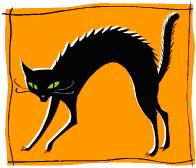 Even as a child, Walhydra remembers, she had felt an odd, sensual thrill whenever a black cat crossed her path, as if something special and delightful (yet somehow perverse) were about to happen.
She couldn't understand why the other kids on the playground backed away, making strange warding signs, or why they whispered about her rudely if she stood smiling and nodding silently to the little creature.
By her teenage years, she was hanging out with a small circle of nerdy high school friends, spending lunch hours with them at the public library on the corner doing double crostics in the Saturday Review of Literature, and grinning slyly to each other as they roamed the hallways, chanting their mantra: "Mutter, mutter, mumble, mumble, discontent, discontent."
College years almost brought Walhydra to the crisis which finally broke in seminary. Intellectually, she was in hog heaven. (Hogs are among the most intelligent of animals—despite their bad rep.) Linguistics, anthropology, computer science, Telugu and Sanskrit, psychology, German literature...it was wonderful.
When she discovered LOTR during her sophomore year, she knew she had found the sacred text.
But underneath all of this, lurking in her shadowy Virgo heart, the fact that she had been born under a Full Moon was insinuating itself slowly throughout her emotional and psychic life.
In the middle of her junior year she "clutched" (as the architecture and EE students in her dorm used to call it). She couldn't study for exams. She couldn't finish term papers. She took three incompletes...which she finished in an embarrassingly inept manner the next term. She coasted, directionless, through her senior year.
Now she knows that she was going through what used to be called a "nervous breakdown" over her closetedness. But then, watching her imagined career as a "beloved professor of linguistics at an Ivy League college" vanish like moon shadows, she hadn't a clue.
She fell in love with a pixyish boy tenor, also deep in the closet, who shared her dark Lutheran delight in mystery. When he said he was going to seminary, she decided to go, too. He backed out at the last moment. She went on with it, having convinced herself that she was committed to the spiritual life.
(Which was actually true, of course, though in ways far weirder and more rewarding than she then imagined.)
As with her undergraduate years, she at first found genuine challenge and uplift in the mix of theological and biblical studies, worship with a band of equally committed brothers and sisters...and frequent Lutheran beerhall debates into the wee, staggering hours of the night.
Still, the closet door was bulging ominously, mainly due to a roommate who (she now knows, thirty-some years later) was crowded in there with her. She had to come out.
She decided to give a miss to the Gestalt therapy part about talking to empty chairs, recommended by her faculty adviser. Instead, she swept back precipitously into Ithaca, as described above.
And, to the eventual joy and cheers of her newly found straight friends and housemates (who met her at the doorway of her first PRIM-sponsored dance, to which they had convinced her to go), she was finally able to raise her head and shout to the world....
"I LOVE Friday the Thirteenth!"
It was then, while she was in her first year in Lutheran seminary, that she finally realized she couldn't lie to herself anymore—and, better still, that the Divine One did not in fact condemn her for her "difference," regardless of what the Church and most of Western civilization had to say.
Finding her courage, she dropped out, moved back to her beloved college town of Ithaca, found some liberal friends—and joined the then fledgling and little-known Paraskavedekatriaphile Rights Movement (aka PRIM).
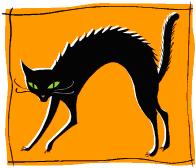 Even as a child, Walhydra remembers, she had felt an odd, sensual thrill whenever a black cat crossed her path, as if something special and delightful (yet somehow perverse) were about to happen.
She couldn't understand why the other kids on the playground backed away, making strange warding signs, or why they whispered about her rudely if she stood smiling and nodding silently to the little creature.
By her teenage years, she was hanging out with a small circle of nerdy high school friends, spending lunch hours with them at the public library on the corner doing double crostics in the Saturday Review of Literature, and grinning slyly to each other as they roamed the hallways, chanting their mantra: "Mutter, mutter, mumble, mumble, discontent, discontent."
College years almost brought Walhydra to the crisis which finally broke in seminary. Intellectually, she was in hog heaven. (Hogs are among the most intelligent of animals—despite their bad rep.) Linguistics, anthropology, computer science, Telugu and Sanskrit, psychology, German literature...it was wonderful.
When she discovered LOTR during her sophomore year, she knew she had found the sacred text.
But underneath all of this, lurking in her shadowy Virgo heart, the fact that she had been born under a Full Moon was insinuating itself slowly throughout her emotional and psychic life.
In the middle of her junior year she "clutched" (as the architecture and EE students in her dorm used to call it). She couldn't study for exams. She couldn't finish term papers. She took three incompletes...which she finished in an embarrassingly inept manner the next term. She coasted, directionless, through her senior year.
Now she knows that she was going through what used to be called a "nervous breakdown" over her closetedness. But then, watching her imagined career as a "beloved professor of linguistics at an Ivy League college" vanish like moon shadows, she hadn't a clue.
She fell in love with a pixyish boy tenor, also deep in the closet, who shared her dark Lutheran delight in mystery. When he said he was going to seminary, she decided to go, too. He backed out at the last moment. She went on with it, having convinced herself that she was committed to the spiritual life.
(Which was actually true, of course, though in ways far weirder and more rewarding than she then imagined.)
As with her undergraduate years, she at first found genuine challenge and uplift in the mix of theological and biblical studies, worship with a band of equally committed brothers and sisters...and frequent Lutheran beerhall debates into the wee, staggering hours of the night.
Still, the closet door was bulging ominously, mainly due to a roommate who (she now knows, thirty-some years later) was crowded in there with her. She had to come out.
She decided to give a miss to the Gestalt therapy part about talking to empty chairs, recommended by her faculty adviser. Instead, she swept back precipitously into Ithaca, as described above.
And, to the eventual joy and cheers of her newly found straight friends and housemates (who met her at the doorway of her first PRIM-sponsored dance, to which they had convinced her to go), she was finally able to raise her head and shout to the world....
"I LOVE Friday the Thirteenth!"
Sunday, October 08, 2006
Corollary 3
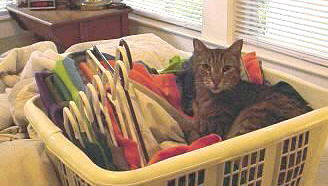
"Clean laundry must first be pressed by the cat to preserve its wrinkles."
—from The Feline Law of Surfaces
—from The Feline Law of Surfaces
Saturday, October 07, 2006

Friday, October 06, 2006
Walhydra’s “Dumb Supper”: or, “Nothing is lost in spirit”
Walhydra realizes that this has been a year of meeting death personally for hubby Jim and herself.
The challenges began just before Candlemas (aka “Imbolc”). Their dear, grand old friend Floyd (aka “Mother”, aka “Watashi Mua, Empress of the Known Universe”) died moments before they reached the door of the family who were hosting him in hospice care.
Surprising herself, Walhydra helped lawyer John prepare Floyd’s body without flinching. Then, joined by an amazing array of straight- and counter-culture acquaintances, they shared a night-long wake out of Tennessee Williams (one of the more comic pieces).
At one point, they stood round an impromptu banquet of Publix food trays and dips in plastic tubs, toasting Floyd with fine champagne in styrofoam cups—half expecting him to stalking regally from the bedroom at any moment to chastise them all for not using crystal flutes.
The next challenge came on St. Patrick’s Day, when Jim’s father James finally tired of rounds of chemotherapy and hospitalization and died in his own home.
Six years ago, Walhydra had watched father and son, two self-made survivors, hug each other with silent tears at the funeral of Jim’s mother. They had not spoken in ten years. During these final years, though, they decided to stop being Southern Baptist at each other (Jim claims to be in recovery) and learned to enjoy holiday visits together.
Since her hubby rarely verbalizes emotions, Walhydra has had to guess at the depth and nature of Jim’s private grief. She takes comfort, though, in the awareness that these two men came finally to like each other. She is secretly amused at how like each other they are. (Don’t tell Jim that.)
Finally, as Walhydra’s faithful readers know, in mid-September, Miso the Cat, affectionate mentor and spiritual guide for over fifteen years, died quickly and quietly at the nice old age of 80+ (16 in human years).
Walhydra has puzzled over the after-effects of this latest death. She remembers, halfway through Floyd’s wake, wandering back to sit alone with his body, and finally being able to sob aloud when she realized, “I can’t talk with this silly genius anymore!” For weeks she had flashes of revisiting that awareness, as did hubby Jim. She supposes Jim may have similar moments of missing his lost and reconciled father.
But what makes missing this...animal...so much more poignant? Walhydra suspects that, in part, it’s because Miso was home. If she was home, he was there—usually whining for more dessert. He followed them from room to room and crowded their feet at night. He was a point of shared affection for Walhydra and hubby, even during their own most difficult years.
Walhydra feels that there is now a spiritual absence in the household.
So, what does all of this have to do with food?
Walhydra knows that the old agricultural calendar of Celtic Europe included three harvests. The first, of barley or grain, was in early August, the second, of grapes, at Autumn Equinox. The final harvest, of fruit and nuts, came right at the cusp of Winter, around October 31st. But this was also when people believed the veil between the living and the dead was the thinnest, when those whom Death had harvested could return to share a meal with their loved ones.
In Gaelic, the festival was called Samhain, “Summer’s End." It was Christianized as All Hallows Eve (Hallowe’en), preface to All Saints Day.
Folk gathered for an end-of-season feast to which they believed they could invite the dear departed by setting out extra places of food and wine. The dead could speak through the stories, jokes and laments their survivors told about them. They called it a “Dumb Supper.”
Now, as Walhydra wrote in her first blog post, she doesn’t know if there’s life after death. Her rational mind—which she knows is a fictional construct of her organism’s brain, handy for organizing information—tells her that, once the body dies, the construct of “individual identity” ceases to exist. So who—or what—would come back to visit?
But Walhydra is still—at least on her better days—a human being. She remembers. Her memories have real effect in the present in terms of feeling, emotion, thought, action. So she figures whenever she remembers someone, that person is actually there.
Her hero, Jesus, said that would be true whenever his friends ate and drank together. Certainly Mother Floyd had not yet left the building when his admirers shared the banquet from Publix. And, when Walhydra and Jim first hosted a Dumb Supper for the local Quaker Meeting, they met all sorts of people who had “crossed over” into death, in the loving tales of their living guests.
Hubby Jim says he’s planning a Dumb Supper for some of Floyd’s friends, probably the weekend before Samhain. Walhydra is glad—though it promises to hit closer to home than in previous years.
She doesn’t know yet, but she’ll probably put out a dish of Miso’s favorite cat food. Or, better yet, cheese!
The challenges began just before Candlemas (aka “Imbolc”). Their dear, grand old friend Floyd (aka “Mother”, aka “Watashi Mua, Empress of the Known Universe”) died moments before they reached the door of the family who were hosting him in hospice care.
Surprising herself, Walhydra helped lawyer John prepare Floyd’s body without flinching. Then, joined by an amazing array of straight- and counter-culture acquaintances, they shared a night-long wake out of Tennessee Williams (one of the more comic pieces).
At one point, they stood round an impromptu banquet of Publix food trays and dips in plastic tubs, toasting Floyd with fine champagne in styrofoam cups—half expecting him to stalking regally from the bedroom at any moment to chastise them all for not using crystal flutes.
The next challenge came on St. Patrick’s Day, when Jim’s father James finally tired of rounds of chemotherapy and hospitalization and died in his own home.
Six years ago, Walhydra had watched father and son, two self-made survivors, hug each other with silent tears at the funeral of Jim’s mother. They had not spoken in ten years. During these final years, though, they decided to stop being Southern Baptist at each other (Jim claims to be in recovery) and learned to enjoy holiday visits together.
Since her hubby rarely verbalizes emotions, Walhydra has had to guess at the depth and nature of Jim’s private grief. She takes comfort, though, in the awareness that these two men came finally to like each other. She is secretly amused at how like each other they are. (Don’t tell Jim that.)
Finally, as Walhydra’s faithful readers know, in mid-September, Miso the Cat, affectionate mentor and spiritual guide for over fifteen years, died quickly and quietly at the nice old age of 80+ (16 in human years).
Walhydra has puzzled over the after-effects of this latest death. She remembers, halfway through Floyd’s wake, wandering back to sit alone with his body, and finally being able to sob aloud when she realized, “I can’t talk with this silly genius anymore!” For weeks she had flashes of revisiting that awareness, as did hubby Jim. She supposes Jim may have similar moments of missing his lost and reconciled father.
But what makes missing this...animal...so much more poignant? Walhydra suspects that, in part, it’s because Miso was home. If she was home, he was there—usually whining for more dessert. He followed them from room to room and crowded their feet at night. He was a point of shared affection for Walhydra and hubby, even during their own most difficult years.
Walhydra feels that there is now a spiritual absence in the household.
So, what does all of this have to do with food?
Walhydra knows that the old agricultural calendar of Celtic Europe included three harvests. The first, of barley or grain, was in early August, the second, of grapes, at Autumn Equinox. The final harvest, of fruit and nuts, came right at the cusp of Winter, around October 31st. But this was also when people believed the veil between the living and the dead was the thinnest, when those whom Death had harvested could return to share a meal with their loved ones.
In Gaelic, the festival was called Samhain, “Summer’s End." It was Christianized as All Hallows Eve (Hallowe’en), preface to All Saints Day.
Folk gathered for an end-of-season feast to which they believed they could invite the dear departed by setting out extra places of food and wine. The dead could speak through the stories, jokes and laments their survivors told about them. They called it a “Dumb Supper.”
Now, as Walhydra wrote in her first blog post, she doesn’t know if there’s life after death. Her rational mind—which she knows is a fictional construct of her organism’s brain, handy for organizing information—tells her that, once the body dies, the construct of “individual identity” ceases to exist. So who—or what—would come back to visit?
But Walhydra is still—at least on her better days—a human being. She remembers. Her memories have real effect in the present in terms of feeling, emotion, thought, action. So she figures whenever she remembers someone, that person is actually there.
Her hero, Jesus, said that would be true whenever his friends ate and drank together. Certainly Mother Floyd had not yet left the building when his admirers shared the banquet from Publix. And, when Walhydra and Jim first hosted a Dumb Supper for the local Quaker Meeting, they met all sorts of people who had “crossed over” into death, in the loving tales of their living guests.
Hubby Jim says he’s planning a Dumb Supper for some of Floyd’s friends, probably the weekend before Samhain. Walhydra is glad—though it promises to hit closer to home than in previous years.
She doesn’t know yet, but she’ll probably put out a dish of Miso’s favorite cat food. Or, better yet, cheese!
Thursday, October 05, 2006
Poor Richard Redux: A Manifesto
Walhydra's current incarnational manifestation, the fifty-something, etc., works as a senior librarian in a large, county-wide public library system.
In response to a library system "town meeting," he has written the following essay and posted it to the library's discussion board on the city's website.
Walhydra is proud enough of his having gotten a burr up his you-know-what and acted, that she herewith publishes the whole thing, without further comment:
In response to a library system "town meeting," he has written the following essay and posted it to the library's discussion board on the city's website.
Walhydra is proud enough of his having gotten a burr up his you-know-what and acted, that she herewith publishes the whole thing, without further comment:
I want to propose something far more radical than the "get with the future," market-driven message we library professionals are hearing these days. The focus of that message is almost wholly on competing for consumers who expect the latest in automated and online delivery of public library services. I did hear that warning and take it to heart in library school seven years ago. However, I joined and remain in the profession because of a more sacred set of librarianship values.
The roots of the American public library lie with Benjamin Franklin and his peers, who believed that "life, liberty, and the pursuit of happiness" depended upon free and equal access to information. They thought it important that information and the ability to search for, have access to and use it should not be solely the province of those privileged by prosperity or status.
Franklin himself began as an apprentice tradesman and built his career from scratch. He wanted to be sure that any other American had the means—underwritten at public expense, if necessary—to do the same. He knew that he had made his success through his own literacy, through his access to information, and through his freedom to use it, independent of the mediation or control of others.
We now have a culture in which only those with the advantage of computer and Internet access and the knowledge of how to use these tools can even get to much of the daily information which is most important for living successfully in American society. Even many basic government and commercial services are now almost inaccessible without the ability to connect to and use websites, online forms, email, office software, etc.
I’m sure that others of my colleagues have had the experience of trying to help someone who was told by an employee of the unemployment service, “Go to the public library, get on our website, and fill out the application.” Likely others have had to help a middle-aged or immigrant job hunter, possibly one with a lifetime of competence in his or her trade, now trying to find and complete the mandatory online application for a new job. You all have your own examples.
The new jargon refers to those who have grown up in the online world as “digital natives.” Those of us who entered the work world before PCs, but who have had the privilege of learning to use and perhaps of owning them, are “digital immigrants.” We somehow manage to keep up—sometimes holding on by our fingernails—as e-technology speeds away from us.
My concern here is for the very large population of immigrant and native residents who are “digital refugees.” Whether or not they know how to use these new technologies, our culture now expects them to join the “wired world” if they want access to the benefits and prosperity America has claimed for its successful citizens.
As our library system leaps ahead toward a 21st century refit, which will increasingly automate basic circulation and search services, I believe it is essential that the staff thus freed from mundane tasks be redirected with all deliberateness into what used to be called “library instruction.”
Every branch should have staff with the training, the resources and—especially—the dedicated time to teach people computer and Internet literacy. It should become a core service, developed and coordinated system-wide, for us to seek out and assist those who are struggling or being left behind in this digital age. It could be part of every public service staff person’s job description and performance plan to create, contribute to or participate in such instructional activities.
We library staff all have the advantage—the privilege—of having built successful careers in this new world. Yet if our library’s mandate is only to satisfy the consumer wishes of people who are already “on the cutting edge,” then we are failing the basic purpose of the public library: to make certain that everyone has free and equal access to what we provide at public expense.
Sunday, October 01, 2006

Subscribe to:
Posts (Atom)